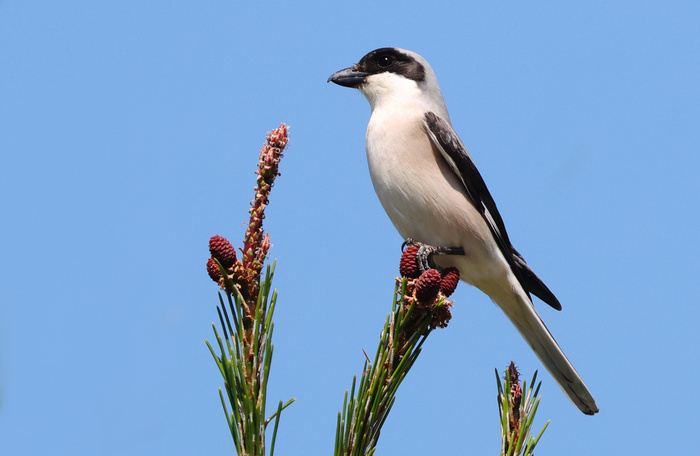
Lesser Grey Shrike.
08th May 2026
Undoubtably the most difficult shrike to see on the island of Lesvos is the Lesser Grey Shrike. They are much less common than the other three shrikes likely to be encountered, these being Masked, Woodchat and Red-backed. These birds spend less than four months on their breeding grounds in Southern Europe before returning to their South African wintering quarters.
I’m always on the lookout for them, usually without much success, but while driving along a long straight road I could see a bird on the top of a roadside bush in the distance. I thought Woodchat or Red backed because Masked are usually in much denser habitat than that.
I stopped the car and I could now see it was a Lesser Grey. I stopped some fifty yards short because these birds are usually very flighty and I fully expected it to fly off as soon as I exited the car, but it stayed put – unusual!
I shot a few frames then very slowly walked towards it taking a few shots before walking nearer. This is a technique I have always adopted, because if the bird flies away at least you have something. However, this bird exhibited total indifference to my approach and unbelievably stayed perched in the same place when I was as little as ten yards away, quite unbelievable really - behaviour I have never encountered before with this species.
I wasn’t complaining and I had a real close-up experience with this lovely bird.
Note the pinkish wash to its underparts.
Smart birds.
I’m always on the lookout for them, usually without much success, but while driving along a long straight road I could see a bird on the top of a roadside bush in the distance. I thought Woodchat or Red backed because Masked are usually in much denser habitat than that.
I stopped the car and I could now see it was a Lesser Grey. I stopped some fifty yards short because these birds are usually very flighty and I fully expected it to fly off as soon as I exited the car, but it stayed put – unusual!
I shot a few frames then very slowly walked towards it taking a few shots before walking nearer. This is a technique I have always adopted, because if the bird flies away at least you have something. However, this bird exhibited total indifference to my approach and unbelievably stayed perched in the same place when I was as little as ten yards away, quite unbelievable really - behaviour I have never encountered before with this species.
I wasn’t complaining and I had a real close-up experience with this lovely bird.
Note the pinkish wash to its underparts.
Smart birds.