Night Herons.
22nd May 2026
Night Herons are different to other Herons, insomuch as they, as their name indicates, operate between dusk and dawn. Their genus name, derived from the Greek is Nycticorax or Night Raven, this is because of their nocturnal habits and also their barking call like a corvid.
They are very widespread birds and exist on every continent except Antarctica. They possess very good eyesight, especially in low light and they are also very clever and are known to lure fish and other amphibians by baiting the water with light coloured sticks and other material that attract their prey.
Sometimes they can be located roosting in tree tops or alternatively low down in riverside vegetation. They often roost in large numbers, as many as fifty to a hundred birds. Unfortunately, they are usually in cover and as a result obscured from view, but sometimes you can get lucky.
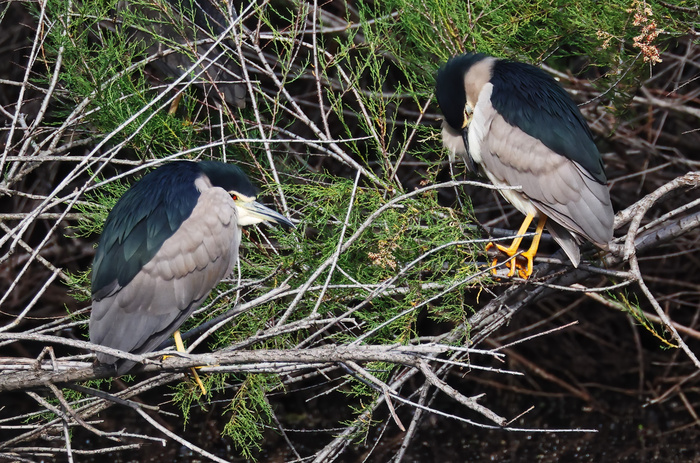
One bird asleep and the other half so.
They are one of my favourite Herons, probably because of this behaviour.
They are very widespread birds and exist on every continent except Antarctica. They possess very good eyesight, especially in low light and they are also very clever and are known to lure fish and other amphibians by baiting the water with light coloured sticks and other material that attract their prey.
Sometimes they can be located roosting in tree tops or alternatively low down in riverside vegetation. They often roost in large numbers, as many as fifty to a hundred birds. Unfortunately, they are usually in cover and as a result obscured from view, but sometimes you can get lucky.
One bird asleep and the other half so.
They are one of my favourite Herons, probably because of this behaviour.