Northern Carmine Bee Eater flight sequence.
15th October 2026
In a previous blog post I wrote about finally realising a long-awaited desire to see and photograph Northern Carmine Bee Eaters. This was a deeply held personal ambition which took me five years to achieve. This is because it’s one thing to just see them through binoculars, as many people do, but it’s another much more difficult undertaking to get them flying in front of your lens and ultimately getting some decent flight shots.
I have been creating some sequential shots of flying birds lately, the last one being a Hobby, in a previous blog, seen at Llangors Lake in the Brecon Beacons near where I live.
By extension I thought I’d create one of a Northern Carmine Bee Eater I photographed in Africa this year.
This process is quite straightforward, you just need suitable images, i.e. a few shots of a bird flying (obviously) and which is ideally against a plain background, but if you want you can use any plain background you have naturally photographed or even manufactured - That is quite simple.
I emphasize a plain background because it’s then much simpler to draw around a subject in photoshop, this is because the programme recognizes the subject’s outline easier because of the contrast between the two. When your shot selection is chosen, perhaps five or six images, it’s then just a matter of blending them one by one onto the plain background.
This is an easy procedure in photoshop - after opening up your chosen background, then also open up the first bird image and carefully draw around it, subsequently follow a few simple steps to mask the original background, thereby isolating the bird, then copy and paste the bird image onto the chosen background. You can also arrange the images in any order, alter their size or orientation to suit the final sequential composition.
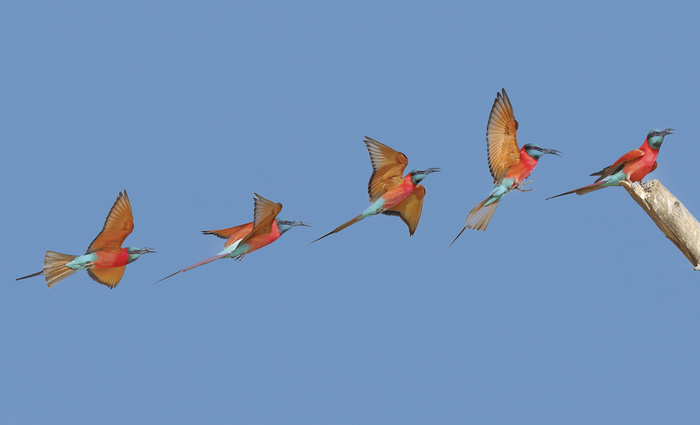
These creations highlight a bird’s transition in flight much clearer than just looking at individual images one by one.
I have been creating some sequential shots of flying birds lately, the last one being a Hobby, in a previous blog, seen at Llangors Lake in the Brecon Beacons near where I live.
By extension I thought I’d create one of a Northern Carmine Bee Eater I photographed in Africa this year.
This process is quite straightforward, you just need suitable images, i.e. a few shots of a bird flying (obviously) and which is ideally against a plain background, but if you want you can use any plain background you have naturally photographed or even manufactured - That is quite simple.
I emphasize a plain background because it’s then much simpler to draw around a subject in photoshop, this is because the programme recognizes the subject’s outline easier because of the contrast between the two. When your shot selection is chosen, perhaps five or six images, it’s then just a matter of blending them one by one onto the plain background.
This is an easy procedure in photoshop - after opening up your chosen background, then also open up the first bird image and carefully draw around it, subsequently follow a few simple steps to mask the original background, thereby isolating the bird, then copy and paste the bird image onto the chosen background. You can also arrange the images in any order, alter their size or orientation to suit the final sequential composition.
These creations highlight a bird’s transition in flight much clearer than just looking at individual images one by one.