News
Looking for Crossbills in Winter.
19th January 2025
19th January 2025
Yesterday Susan and I went looking for Common Crossbills. We knew it was a difficult undertaking to get them up close for a photograph because the only views a birder usually gets of these birds is up high in conifer trees, particularly Larch, as these cone seeds appear to be their favourite food source.
Crossbills are a specialist feeder, their beaks overlap allowing them to prise open conifer cones and then extract the seeds with their tongues. They tend to roam a lot flying above conifer plantations looking for appropriate trees with a good crop of cones. This food source is available throughout the winter and this allows these birds to breed very early and indeed after some looking and waiting a few birds flew into a larch tree, although up high as usual, and started to feed. Then there was a first for us as a pair mated briefly before frustratingly flying off, we have never seen this before so a very good sighting.
Another problem with these birds is that there is such a large food source for them in these conifer plantations so they can appear anywhere. The best clue to their presence is their distinctive fluty ‘Clipping’ call as they fly over and a birder must master this call if they want to pin them down. Also if you can hear cones falling down then it’s usually because Crossbills are feeding and dropping cones.
Importantly, Crossbills need to drink frequently because of the nature of their diet and if you can find their ’Watering Hole’ then you really are in business. However, this is more easily said than done and is usually pure luck.
After a good walk around with only brief views we came back to the car had some coffee and just stood beneath the larches we had seen them in previously. Four or five birds appeared after ten minutes, but high up and silhouetted against the sky – no good for a photo. Then two birds started to drop down to lower branches and feed, still a bit high though, then one male bird dropped right down onto the top of a larch sampling about ten feet above the ground. I have seen this behaviour before but you have to react quickly, I took five steps forward and then shot him hand held. These birds are not inordinately shy but there’s a limit and he flew quickly back up high into the tree tops.
However, on checking I could see I had some sort of a shot, at least I had more than I had expected. Most days after looking for Crossbills you come home empty handed, but today I had something – worth the effort.
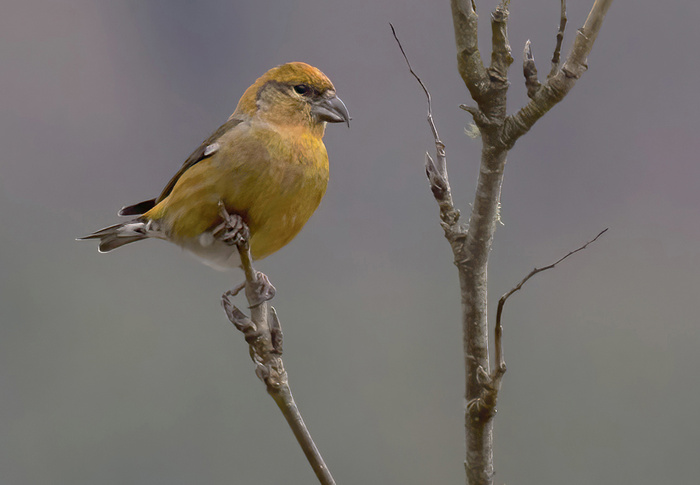
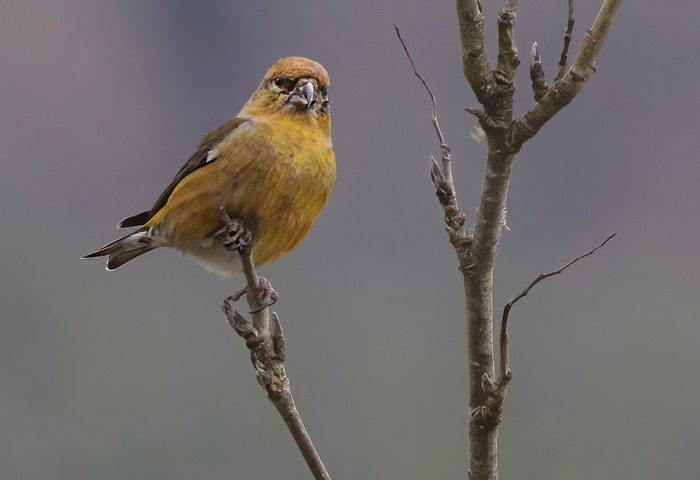
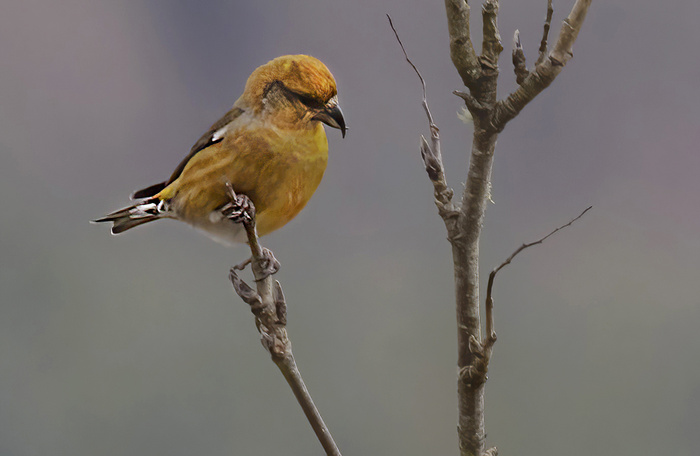
Canon R5 / Canon 100-500 f7.1 lens with a 1.4 tele converter - Handheld.
Crossbills are a specialist feeder, their beaks overlap allowing them to prise open conifer cones and then extract the seeds with their tongues. They tend to roam a lot flying above conifer plantations looking for appropriate trees with a good crop of cones. This food source is available throughout the winter and this allows these birds to breed very early and indeed after some looking and waiting a few birds flew into a larch tree, although up high as usual, and started to feed. Then there was a first for us as a pair mated briefly before frustratingly flying off, we have never seen this before so a very good sighting.
Another problem with these birds is that there is such a large food source for them in these conifer plantations so they can appear anywhere. The best clue to their presence is their distinctive fluty ‘Clipping’ call as they fly over and a birder must master this call if they want to pin them down. Also if you can hear cones falling down then it’s usually because Crossbills are feeding and dropping cones.
Importantly, Crossbills need to drink frequently because of the nature of their diet and if you can find their ’Watering Hole’ then you really are in business. However, this is more easily said than done and is usually pure luck.
After a good walk around with only brief views we came back to the car had some coffee and just stood beneath the larches we had seen them in previously. Four or five birds appeared after ten minutes, but high up and silhouetted against the sky – no good for a photo. Then two birds started to drop down to lower branches and feed, still a bit high though, then one male bird dropped right down onto the top of a larch sampling about ten feet above the ground. I have seen this behaviour before but you have to react quickly, I took five steps forward and then shot him hand held. These birds are not inordinately shy but there’s a limit and he flew quickly back up high into the tree tops.
However, on checking I could see I had some sort of a shot, at least I had more than I had expected. Most days after looking for Crossbills you come home empty handed, but today I had something – worth the effort.
Canon R5 / Canon 100-500 f7.1 lens with a 1.4 tele converter - Handheld.
Shortie.
08th January 2025
08th January 2025
It was Norfolk 2012 during a particularly cold spell and good numbers of Short-eared Owls were in the county. Norfolk is primarily a Barn Owl county with very good numbers resident because of the eminently suitable habitat. Short-eared Owls, however, are more difficult because of fluctuating numbers depending on migratory birds and vole populations in other countries.
There was an area of little known about private land, primarily rough coastal pasture, which Owls and the odd Harrier occupied during late autumn and winter and where there was very limited access, and as a result only locals visited.
A particular path about two hundred yards long led out onto this rough pasture but stopped abruptly at a five bar gate saying ‘No Access’. Nevertheless this narrow path, enclosed by hawthorns, was perfect cover for a bird watcher.
One late afternoon I walked this path and made myself as comfortable as possible down below the five bar gate which also served as partial cover. A Barn Owl started to ‘quarter’ the pasture and I had reasonable views as it drifted past a couple of times.
Pheasants and partridges foraged for worms and insects and a distant Curlew’s call echoed across the pasture.
I could see a Short-eared Owl also hunting the pasture and it had now perched on a fence post about forty yards away. However, this was a very difficult situation photographically because almost all of the fence posts between the bird and me, sat behind the gate, would be in any shot I attempted then. Either the bird or I would have to be nearer, and unfortunately there was no further access for me. I toyed with the idea of standing up and shooting from above the gate thereby gaining a slightly better perspective but realistically I knew this would undoubtedly spook the owl and that would be the end of it.
Then for whatever reason the owl flew and perched a few posts nearer to me, my hopes and indeed my heart beats were raised!
To illustrate the geography of the situation, the fence posts followed a straight line towards me until the last four posts angled away from the gate I was hiding behind in a dog-leg fashion, presumably following a ditch the other side of the fence. At this dog-leg juncture there was a larger post to anchor the fence for its change of direction.
In my mind if the Owl perched on the larger post at the dog-leg then there would be no further posts in the foreground of any shot I took apart from the post the owl was perched on. In addition the background would be perfectly blurred with the green pasture behind.
The owl continued to scan the rough pasture for prey, dropping down periodically and most tantalisingly re-perching one by one onto a post ever nearer to me. I only had two more posts to go before the large anchor post and then this conundrum would be resolved. This really was an intriguing scenario because presumably the bird hadn’t detected me either.
There appeared to be a sense of inevitability unfolding, or perhaps it was just me hoping against hope. I waited daring not to make a sound or movement, my lens was pointed right at that large fence post on the dog-leg.
Then the owl dropped down again and flew back up but didn’t perch, it flew off, I was so disappointed, but then inconceivably it circled back around and perched right on the dog-leg post where I had originally hoped.
I can still see those piercing yellow eyes looking right in my direction.
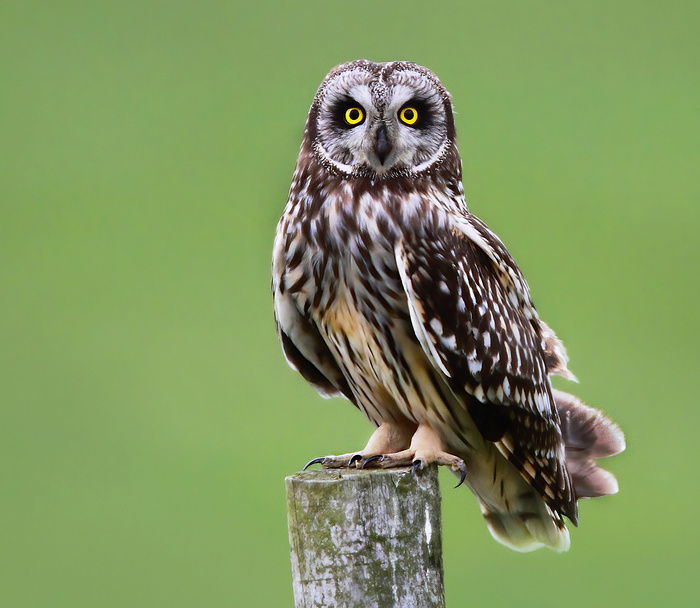
I shot it with an overwhelming sense of achievement and it remained there for a minute before flying off into the now rapidly fading afternoon light – the closest I have ever been to a Short-eared Owl.
There was an area of little known about private land, primarily rough coastal pasture, which Owls and the odd Harrier occupied during late autumn and winter and where there was very limited access, and as a result only locals visited.
A particular path about two hundred yards long led out onto this rough pasture but stopped abruptly at a five bar gate saying ‘No Access’. Nevertheless this narrow path, enclosed by hawthorns, was perfect cover for a bird watcher.
One late afternoon I walked this path and made myself as comfortable as possible down below the five bar gate which also served as partial cover. A Barn Owl started to ‘quarter’ the pasture and I had reasonable views as it drifted past a couple of times.
Pheasants and partridges foraged for worms and insects and a distant Curlew’s call echoed across the pasture.
I could see a Short-eared Owl also hunting the pasture and it had now perched on a fence post about forty yards away. However, this was a very difficult situation photographically because almost all of the fence posts between the bird and me, sat behind the gate, would be in any shot I attempted then. Either the bird or I would have to be nearer, and unfortunately there was no further access for me. I toyed with the idea of standing up and shooting from above the gate thereby gaining a slightly better perspective but realistically I knew this would undoubtedly spook the owl and that would be the end of it.
Then for whatever reason the owl flew and perched a few posts nearer to me, my hopes and indeed my heart beats were raised!
To illustrate the geography of the situation, the fence posts followed a straight line towards me until the last four posts angled away from the gate I was hiding behind in a dog-leg fashion, presumably following a ditch the other side of the fence. At this dog-leg juncture there was a larger post to anchor the fence for its change of direction.
In my mind if the Owl perched on the larger post at the dog-leg then there would be no further posts in the foreground of any shot I took apart from the post the owl was perched on. In addition the background would be perfectly blurred with the green pasture behind.
The owl continued to scan the rough pasture for prey, dropping down periodically and most tantalisingly re-perching one by one onto a post ever nearer to me. I only had two more posts to go before the large anchor post and then this conundrum would be resolved. This really was an intriguing scenario because presumably the bird hadn’t detected me either.
There appeared to be a sense of inevitability unfolding, or perhaps it was just me hoping against hope. I waited daring not to make a sound or movement, my lens was pointed right at that large fence post on the dog-leg.
Then the owl dropped down again and flew back up but didn’t perch, it flew off, I was so disappointed, but then inconceivably it circled back around and perched right on the dog-leg post where I had originally hoped.
I can still see those piercing yellow eyes looking right in my direction.
I shot it with an overwhelming sense of achievement and it remained there for a minute before flying off into the now rapidly fading afternoon light – the closest I have ever been to a Short-eared Owl.
Great White Egret.
16th November 2024
16th November 2024
Great White Egrets have been resident at Llangors Lake in the Brecon Beacons for a few years and hopefully breeding is on the horizon. They remain, however, as do all Herons and Egrets painfully shy, and you usually have to take them by surprise to get near them. I was walking back from the bird hide there, where I had basically seen very little, when this bird took off and flew across me for about five seconds. I was carrying my Canon R5 with the RF100-500 f7.1 and the RF 1.4 TC attached - my standard combo these days, but even with the 1.4 TC attached and at 1120mm the camera locked onto the bird’s eye immediately.
This combo is very effective for walking around photography.
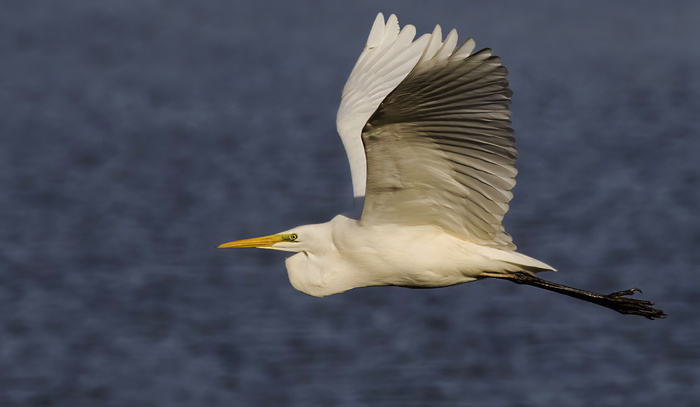
This combo is very effective for walking around photography.
A week in North Norfolk.
01st November 2024
01st November 2024
Susan and I have just arrived back from a week in North Norfolk where we visited some of our old haunts. The scale of new house building in these coastal villages is undiminished since our last visit a few years ago. These villages once occupied by fishermen and boat builders have been invaded by obviously rich retired people or extremely rich ‘second home’ Londoners. Multi-million pound dwellings designed no doubt by expensive architects are mushrooming throughout. Bespoke tradesmen using only the best materials can be seen working on these constructions. Aston Martin, Porsche, Ferrari, Bentley and many other expensive vehicles adorn the driveways of the already built houses. If anyone wants to see how the other half live then this is a place to do it.
Thankfully the marshes remain and for now wildlife can still be found. We did a lot of walking around these marshes and along mostly very quiet beaches.
Give me a beach in winter anytime!
The geese were there in large numbers and it’s lovely to see ‘V’ shaped skeins of these birds flying across big open skies while uttering their haunting calls.
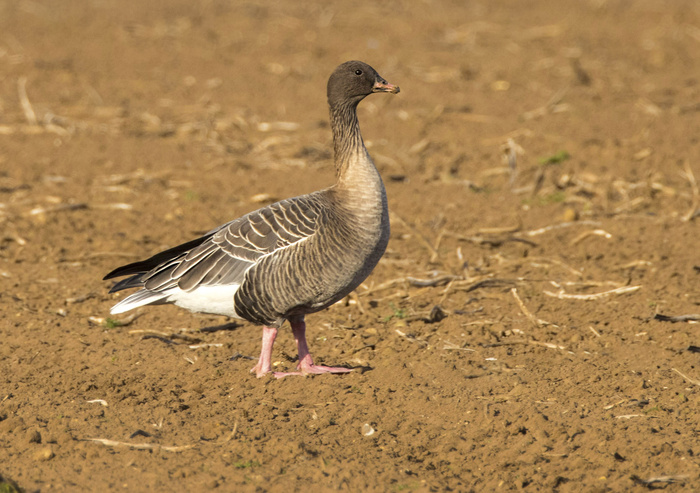
Pink-footed Goose.
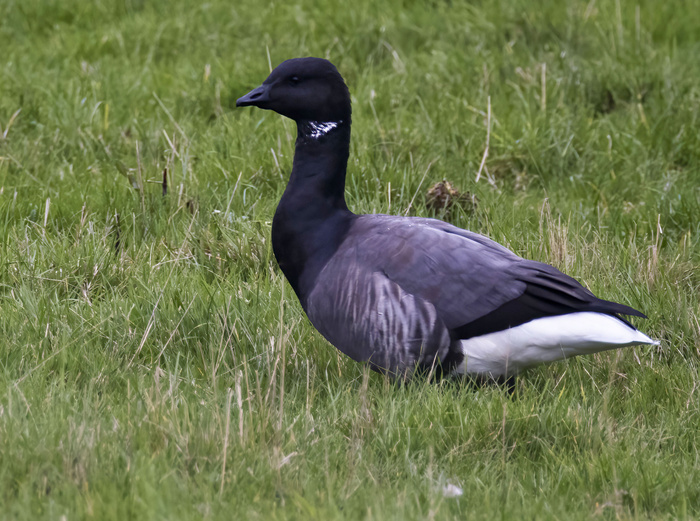
Brent Goose
However, November is late and water levels in the bird reserves are high and wader populations as a consequence are low, just the usual Redshank, Curlew, Black-tailed Godwit and the odd Common Snipe to be found.
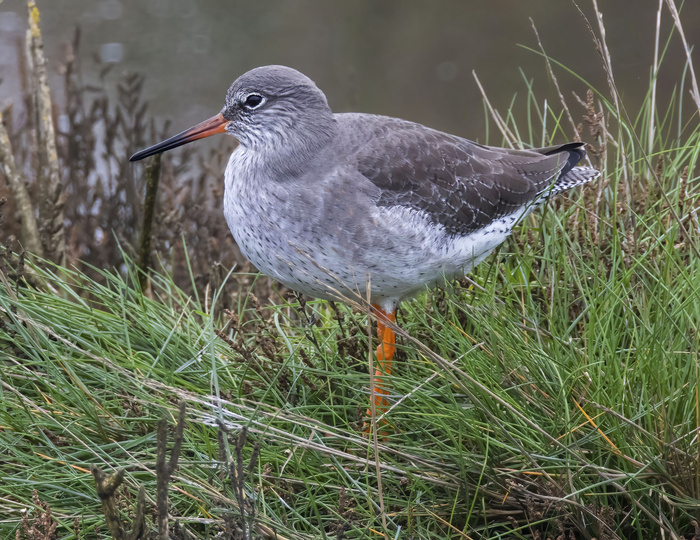
Redshank
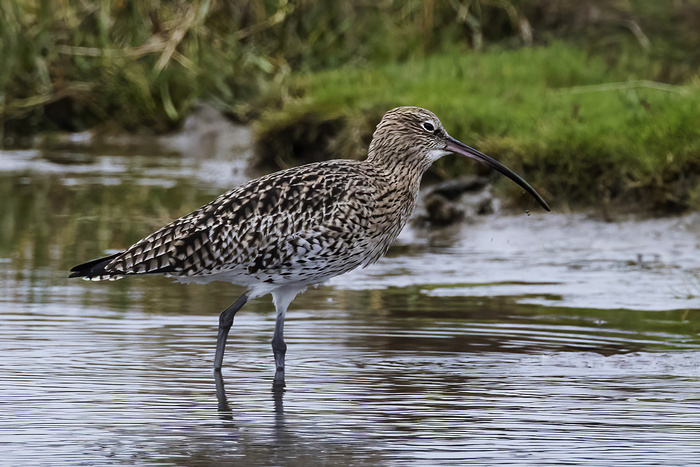
Curlew
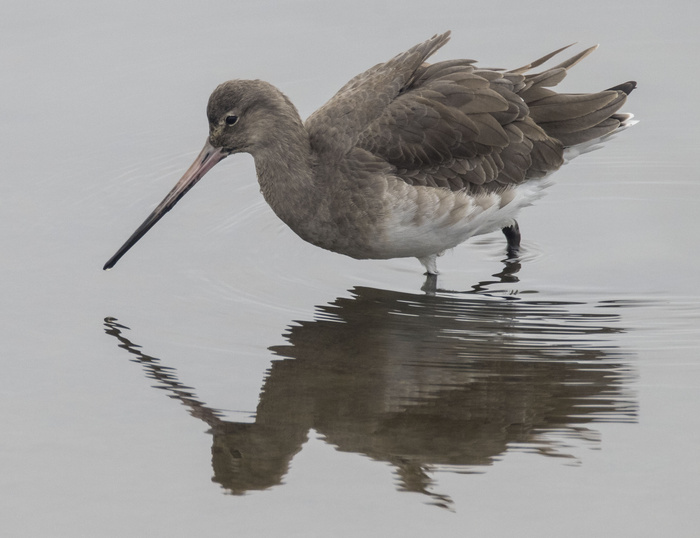
Black-tailed Godwit
Bearded Tits have all but disappeared until next spring when their ‘Pinging’ calls will again rejuvenate the reedbeds.
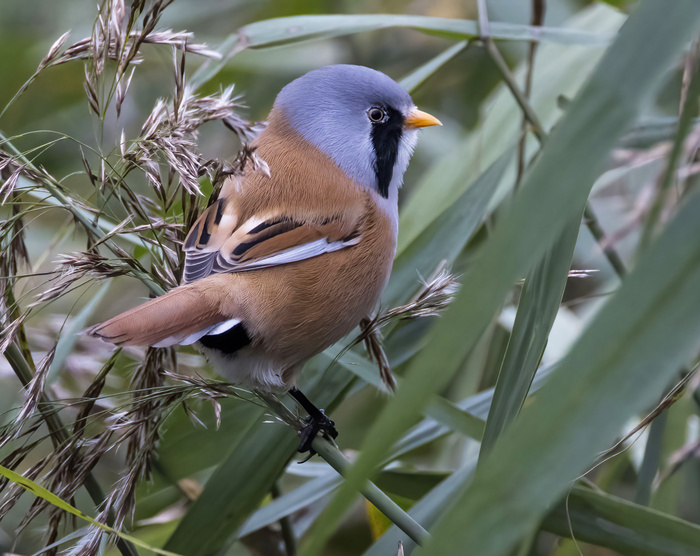
Bearded Tit
Different birds arrive for the winter, Divers and Grebes occupy the sea.
Snow Buntings can be seen in small numbers foraging on the tideline.
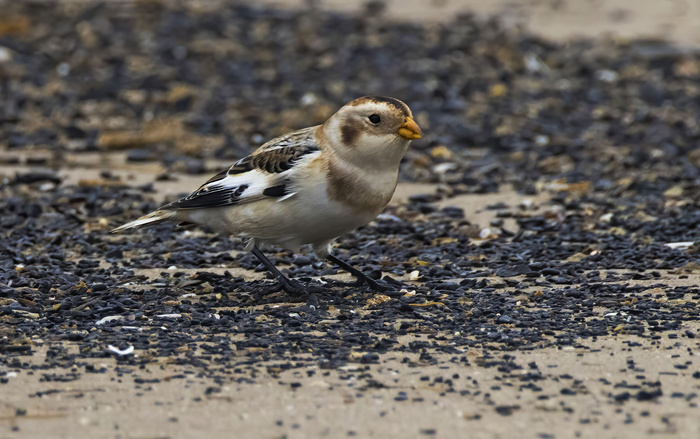
Snow Bunting
Elusive Shore Larks spend the winter in coastal margins.
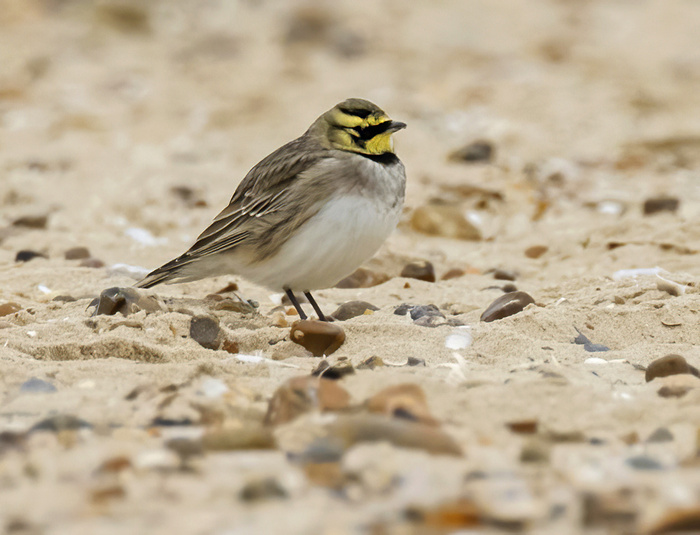
Shore Lark
and Twite, a sparse breeding bird in the UK
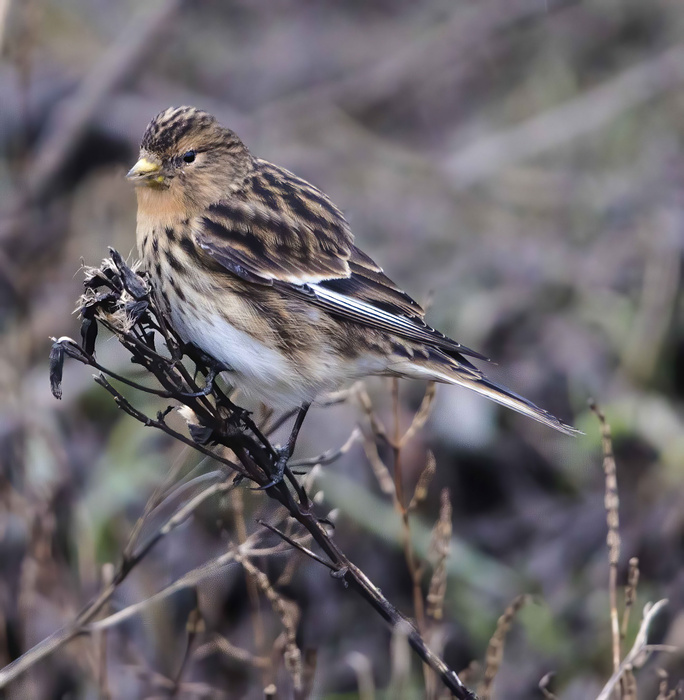
It was a very relaxing and therapeutic time and it’s so good to have a change of scenery and habitat.
Back home now and another year is rapidly coming to an end and before long the festive season will be upon us. Let’s hope for some more traditional winter-like weather over the next few months instead of horrible wet and windy spells……..
Thankfully the marshes remain and for now wildlife can still be found. We did a lot of walking around these marshes and along mostly very quiet beaches.
Give me a beach in winter anytime!
The geese were there in large numbers and it’s lovely to see ‘V’ shaped skeins of these birds flying across big open skies while uttering their haunting calls.
Pink-footed Goose.
Brent Goose
However, November is late and water levels in the bird reserves are high and wader populations as a consequence are low, just the usual Redshank, Curlew, Black-tailed Godwit and the odd Common Snipe to be found.
Redshank
Curlew
Black-tailed Godwit
Bearded Tits have all but disappeared until next spring when their ‘Pinging’ calls will again rejuvenate the reedbeds.
Bearded Tit
Different birds arrive for the winter, Divers and Grebes occupy the sea.
Snow Buntings can be seen in small numbers foraging on the tideline.
Snow Bunting
Elusive Shore Larks spend the winter in coastal margins.
Shore Lark
and Twite, a sparse breeding bird in the UK
It was a very relaxing and therapeutic time and it’s so good to have a change of scenery and habitat.
Back home now and another year is rapidly coming to an end and before long the festive season will be upon us. Let’s hope for some more traditional winter-like weather over the next few months instead of horrible wet and windy spells……..
Memorable Moments 5.
29th October 2024
29th October 2024
Nearer home this time.
It was February 2016 during a horrible prolonged wet spell of weather where the fields around Llangors Lake in the Brecon Beacons had been turned into a veritable quagmire. During that winter there was a Barn Owl trying to survive by hunting these fields. Life was obviously really tough for this bird, and of course for Barn Owls in general that winter. Their feathers are not waterproof and if they get wet they can’t fly and therefore lose their ability to hunt and subsequently starve to death.
I had been watching this bird getting soaked regularly in the afternoons, sometimes it was just perched out on a branch looking bedraggled and I really feared for its life. In addition to this I saw it being attacked by a Common Buzzard - it was living on the edge!
However, these birds are made of stern stuff and it appeared to be surviving everything that nature was throwing at it. I eventually saw it catch a couple of voles - finally getting something to eat. After it was out flying on a regular basis and obviously getting stronger and the weather had improved marginally I decided to set up a portable hide near to where I had seen it perching – these birds are creatures of habit.
I waited for three hours, freezing in the hide, it’s cold when you can’t move! Finally in the late afternoon with light fast fading it perched on a nearby branch and then turned around to look over its shoulder straight in my direction – perfect!
Another memorable moment which I’m sure won’t happen again for me at that location.
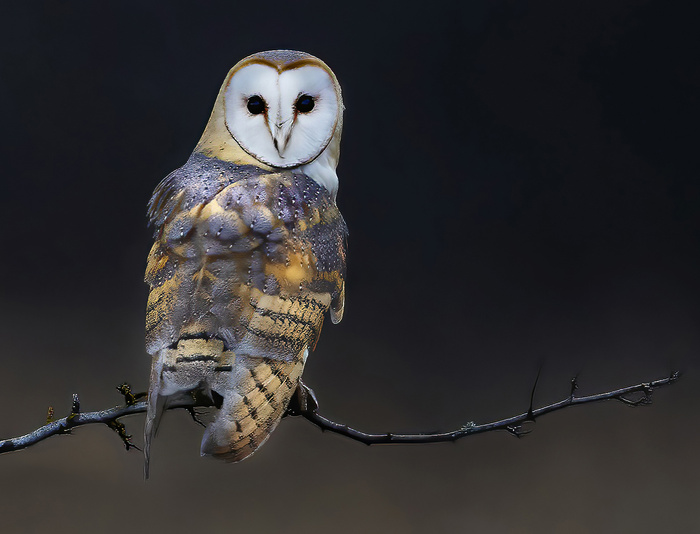
What a bird!
It was February 2016 during a horrible prolonged wet spell of weather where the fields around Llangors Lake in the Brecon Beacons had been turned into a veritable quagmire. During that winter there was a Barn Owl trying to survive by hunting these fields. Life was obviously really tough for this bird, and of course for Barn Owls in general that winter. Their feathers are not waterproof and if they get wet they can’t fly and therefore lose their ability to hunt and subsequently starve to death.
I had been watching this bird getting soaked regularly in the afternoons, sometimes it was just perched out on a branch looking bedraggled and I really feared for its life. In addition to this I saw it being attacked by a Common Buzzard - it was living on the edge!
However, these birds are made of stern stuff and it appeared to be surviving everything that nature was throwing at it. I eventually saw it catch a couple of voles - finally getting something to eat. After it was out flying on a regular basis and obviously getting stronger and the weather had improved marginally I decided to set up a portable hide near to where I had seen it perching – these birds are creatures of habit.
I waited for three hours, freezing in the hide, it’s cold when you can’t move! Finally in the late afternoon with light fast fading it perched on a nearby branch and then turned around to look over its shoulder straight in my direction – perfect!
Another memorable moment which I’m sure won’t happen again for me at that location.
What a bird!
Memorable Moments 4.
10th September 2024
10th September 2024
One of my favourite images (although quite a simple shot) which also became a memorable moment occurred in the Western Ghats in India in 2010. These Ghats are a mountain range that receive large amounts of rain in the monsoon season but other times of the year can be blighted by intense fires.
Walking in the countryside after one of these small fires Susan and I came across a field that had been totally burned out with all the vegetation therein destroyed. Looking closer we could see a Yellow Wattled Lapwing standing right out in the middle looking rather forlorn, almost as if it was wondering where all its habitat had disappeared to.
It looked quite a poignant scene with the bird isolated in amongst the burnt foliage which was smoothed out by the shallow depth of field of a big lens.
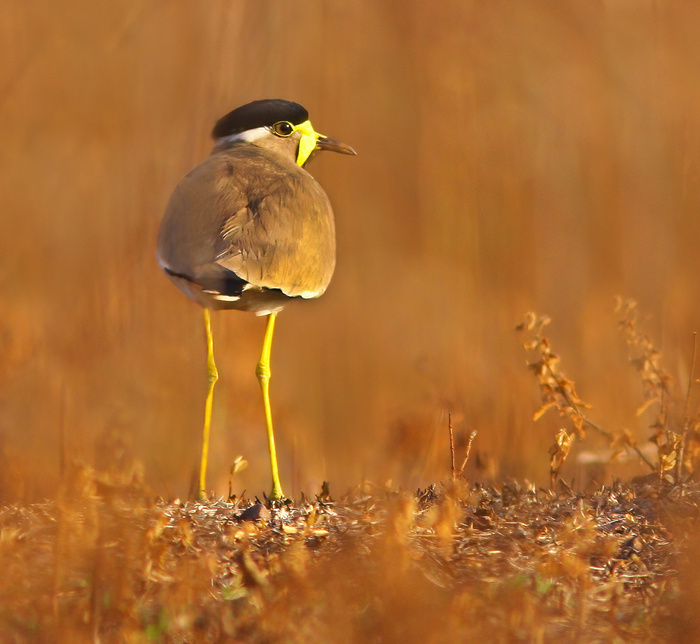
It remains after all this time one of my favourite moments.
Walking in the countryside after one of these small fires Susan and I came across a field that had been totally burned out with all the vegetation therein destroyed. Looking closer we could see a Yellow Wattled Lapwing standing right out in the middle looking rather forlorn, almost as if it was wondering where all its habitat had disappeared to.
It looked quite a poignant scene with the bird isolated in amongst the burnt foliage which was smoothed out by the shallow depth of field of a big lens.
It remains after all this time one of my favourite moments.
Memorable moments 3.
27th August 2024
27th August 2024
In May 2013 after flying to Seville and driving up the almost empty Via de la Plata toll road into Extremadura was a unique experience, because to travel a motorway in the UK that has virtually no vehicles on it is unthinkable. We were staying in very remote accommodation with no neighbours and a really rough track about a mile long to access it. The first time we drove there I exited our car and walked for a few hundred yards further on up the track because I firmly believed we had gone the wrong way, however, we hadn’t made a mistake and the ‘Finca’ we were staying in was very nice and proved to be a veritable wildlife haven.
Hoopoes nested nearby, Bee Eaters flew over all day long, Hawfinches were seen in the various orchards, Golden Orioles sang their fluty song, Azure-winged Magpies were common, Serins and Sardinian Warblers nested by the front gate and up the hill Blue Rock Thrushes occupied a large rocky outcrop. Common Cuckoos, Red-necked Nightjars and Nightingales were very evident in the evening, singing continuously.
Sitting out on the veranda on such an evening with a very good bottle (or two) of local wine bought very cheaply from a shop in a little village on a hillside about five miles away was a very pleasant way to end the day. Extremadura is undoubtably one of the great open spaces of the European continent, early one morning we drove for three hours right into the heart of the plains without seeing another car or person, imagine that in the UK!!
One afternoon at the Finca after a lunch of fresh salad, local ham, cheese and freshly baked bread we decided to go for a walk up the track which was a haven for birds. After numerous encounters with lovely birds and butterflies we headed back down and as we turned a corner and were a crossing a flower filled meadow suddenly an animal appeared right in front of us, out of nowhere. I can’t remember who was the most surprised us or the Egyptian Mongoose standing before us and remarkably holding a large frog in its mouth. It was half wet probably after predating the frog from some nearby water. There was a bit of a ‘Mexican Standoff’ for ten seconds which thankfully allowed me to take a quick shot before it disappeared never to be seen again.
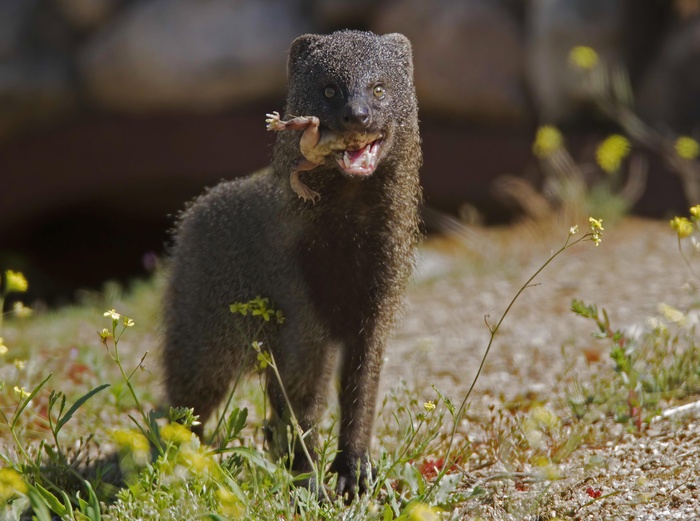
A one off really memorable moment!!
Hoopoes nested nearby, Bee Eaters flew over all day long, Hawfinches were seen in the various orchards, Golden Orioles sang their fluty song, Azure-winged Magpies were common, Serins and Sardinian Warblers nested by the front gate and up the hill Blue Rock Thrushes occupied a large rocky outcrop. Common Cuckoos, Red-necked Nightjars and Nightingales were very evident in the evening, singing continuously.
Sitting out on the veranda on such an evening with a very good bottle (or two) of local wine bought very cheaply from a shop in a little village on a hillside about five miles away was a very pleasant way to end the day. Extremadura is undoubtably one of the great open spaces of the European continent, early one morning we drove for three hours right into the heart of the plains without seeing another car or person, imagine that in the UK!!
One afternoon at the Finca after a lunch of fresh salad, local ham, cheese and freshly baked bread we decided to go for a walk up the track which was a haven for birds. After numerous encounters with lovely birds and butterflies we headed back down and as we turned a corner and were a crossing a flower filled meadow suddenly an animal appeared right in front of us, out of nowhere. I can’t remember who was the most surprised us or the Egyptian Mongoose standing before us and remarkably holding a large frog in its mouth. It was half wet probably after predating the frog from some nearby water. There was a bit of a ‘Mexican Standoff’ for ten seconds which thankfully allowed me to take a quick shot before it disappeared never to be seen again.
A one off really memorable moment!!
Memorable moments 2.
27th August 2024
27th August 2024
Walking in the mountains of Northern China in 2009 was a special experience, the scenery is dramatic to say the least. Soaring peaks above give way to riverine valleys below. Herein there exists a most unusual bird which occupies a narrow and specific ecological niche. Its habitat is very specialized, breeding at high altitudes in river basins where the water flow is slow, preferring these flat areas strewn with pebbles and rounded boulders. These habitats provide the necessary conditions for their nesting and foraging behaviours. They are often found at elevations ranging from 500 to 4,000 meters during the breeding season.
Their varied diet includes insects and their larvae, small crustaceans and fish, which become a more significant part of their diet during the winter months at lower elevations. Their foraging technique is also quite specialized; they use their beaks to probe soft mud, peck at the water’s surface, and rake through gravel to uncover prey. This versatility in foraging behaviour allows them to exploit a variety of food sources throughout the year.
Resembling a bird painted by a whimsical artist, the Ibisbill is characterized by its striking appearance, which includes a long, down-curved beak reminiscent of an Ibis, hence its name.
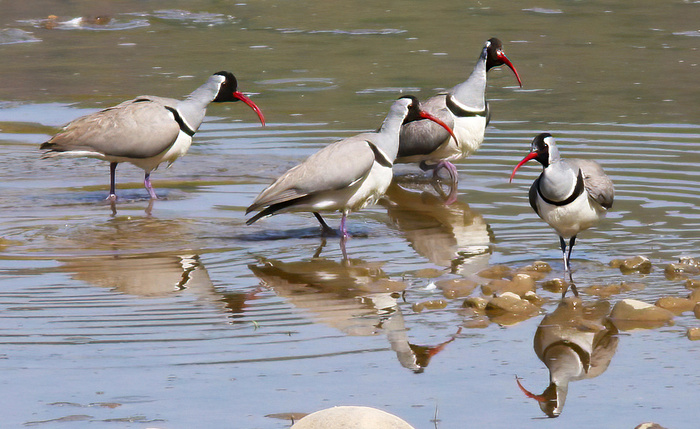
We were extremely lucky to come across a small group of these lovely birds feeding in a typical habitat highlighted above. This encounter was another very memorable moment for us, as it was I’m sure a once in a lifetime sighting.
Their varied diet includes insects and their larvae, small crustaceans and fish, which become a more significant part of their diet during the winter months at lower elevations. Their foraging technique is also quite specialized; they use their beaks to probe soft mud, peck at the water’s surface, and rake through gravel to uncover prey. This versatility in foraging behaviour allows them to exploit a variety of food sources throughout the year.
Resembling a bird painted by a whimsical artist, the Ibisbill is characterized by its striking appearance, which includes a long, down-curved beak reminiscent of an Ibis, hence its name.
We were extremely lucky to come across a small group of these lovely birds feeding in a typical habitat highlighted above. This encounter was another very memorable moment for us, as it was I’m sure a once in a lifetime sighting.
Memorable moments.
25th August 2024
25th August 2024
There are some truly standout moments that stick in my birding memory and on a birding trip to north east China in 2009 there was most definitely one. We had been walking through the grounds of an abandoned hotel which had become really overgrown and the bird life was quite remarkable with huge numbers of warblers at every turn, Yellow Browed, Hume’s, Pallas’s, Dusky, Raddes, and Arctic. Flycatchers flitted around us and little Buntings darted amongst the undergrowth. However, it was difficult to pin these birds down for a photo because of the dense foliage and their fast movements. Nevertheless it was quite an experience to have these rare birds in such numbers all around, any of these is a very good bird back home in the UK.
In amongst this avian extravaganza I could see something moving in the dense undergrowth in front of me, and for some reason and I don’t know why because there was plenty of entertainment around me, I kept watching. Then one of those special birding moments that you never forget happened. A bird just appeared in front of me - a bird I had only ever dreamed of seeing, a male Siberian Rubythroat, just the name sounds so evocative.⁹
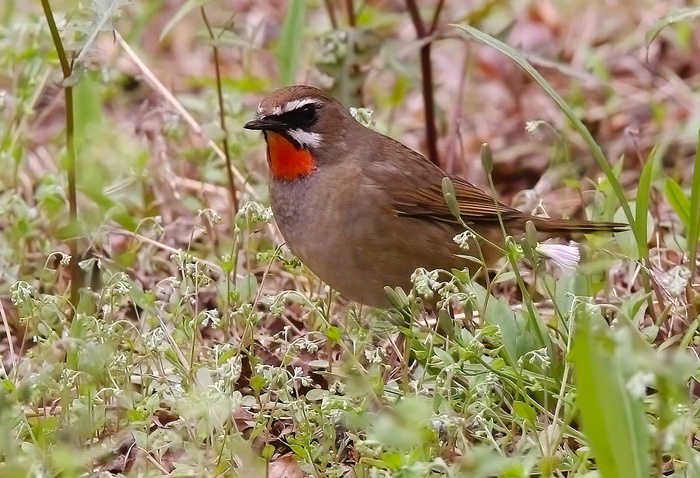
It’s debated to be either a member of the Chat or Old World Flycatcher family, whatever the final conclusion it is a very nice bird indeed and is top of the list for me – I won’t forget it ever.
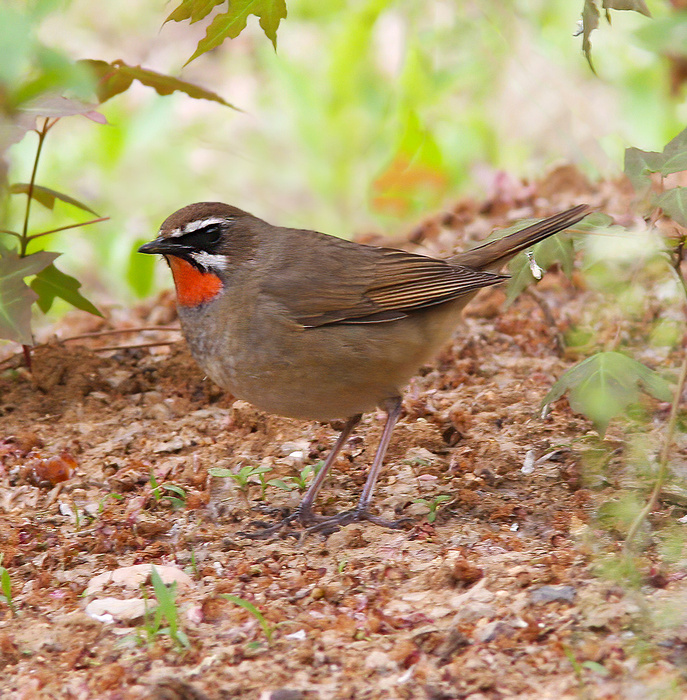
In amongst this avian extravaganza I could see something moving in the dense undergrowth in front of me, and for some reason and I don’t know why because there was plenty of entertainment around me, I kept watching. Then one of those special birding moments that you never forget happened. A bird just appeared in front of me - a bird I had only ever dreamed of seeing, a male Siberian Rubythroat, just the name sounds so evocative.⁹
It’s debated to be either a member of the Chat or Old World Flycatcher family, whatever the final conclusion it is a very nice bird indeed and is top of the list for me – I won’t forget it ever.
The Gambia 2023.
26th June 2024
26th June 2024
Our birding trip to The Gambia in Nov/Dec 2023 is now available in the 'Trip Reports' section on the front page.
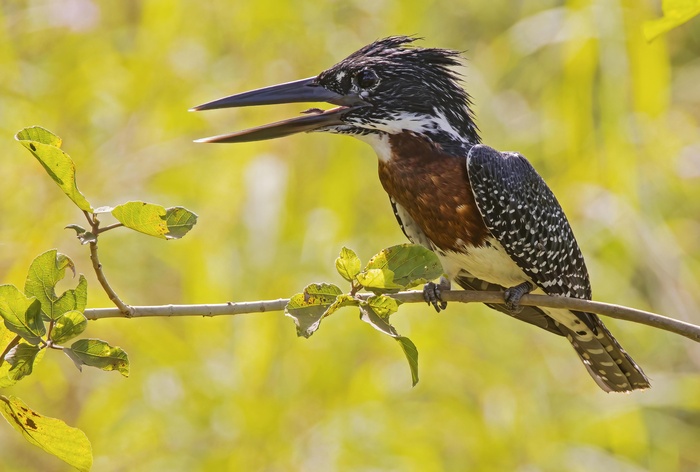
Giant Kingfisher.
Giant Kingfisher.
Ring Ouzels again.
18th June 2024
18th June 2024
Another early morning hike today up onto the high Beacons to see if there was any evidence of Ring Ouzel breeding. In a previous blog I photographed a male bird singing from a prominent position so I was hoping that breeding would take place there. I settled down in the heather with a cold wind blowing over the top of me. You have to try to keep low and find some shelter because exposure to these cold winds can really chill you when you are keeping still.
I had been there about ten minutes sipping small cups of coffee to try and stay warm when I noticed a female Ouzel about 50 yds away landing on a rock and then disappearing into what was obviously a nest – great news!!
You have to keep your distance from these shy birds and allow them to go about the business of rearing their young. It’s vital that their numbers increase and hopefully reverse their worrying decline as a breeding bird in the UK.
I decided to move on but as I was putting my flask away I saw a male bird perched on an isolated post in a grassy area with food in his beak, and then fly over to the nest and deliver food, obviously to the young. There must be young there if both the male and female are back and fore the nest.
I assembled my camera and lens on the off chance and stayed low waiting to see if the male bird would go back into the grassy area where he was obviously looking for food for the young. I couldn’t see him return to the area and I didn’t want to disturb him by rising up and looking over. I waited, and then yes there he was again on the post with more food, I looked through some wispy grass and shot him, he looked at me briefly and then just flew over to the nest site, so not bothered – great!
I walked on down the track away from the grassy area to allow him to return, which he inevitably would in time. It’s not acceptable to try and get more shots of a bird in this situation and risk disturbance! I descended down the mountain with just my single image of the male bird, but more than happy in the knowledge that successful breeding is taken place.
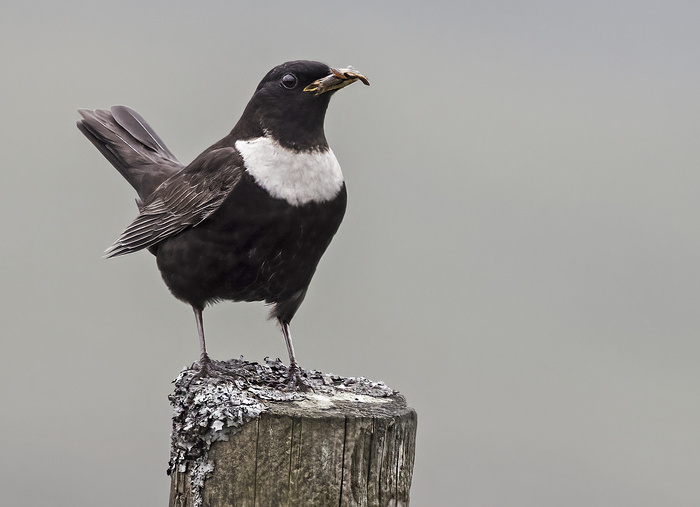
Lovely Bird!
Canon R5 / Canon Rf 100-500 / Canon 1.4 teleconverter
500/sec / f10 / 1120mm / ISO 1000
Some people may baulk at an f10 aperture but using an aperture of this small size creates a deep 'Depth of Field' resulting in a sharp image right across the subject from the beak to the tip of the tail.
These cameras also handle high ISO numbers very well.
With its light weight, easy handling, small size and super sharp image quality the above set-up is a first rate combination for the photographer on the move.
I had been there about ten minutes sipping small cups of coffee to try and stay warm when I noticed a female Ouzel about 50 yds away landing on a rock and then disappearing into what was obviously a nest – great news!!
You have to keep your distance from these shy birds and allow them to go about the business of rearing their young. It’s vital that their numbers increase and hopefully reverse their worrying decline as a breeding bird in the UK.
I decided to move on but as I was putting my flask away I saw a male bird perched on an isolated post in a grassy area with food in his beak, and then fly over to the nest and deliver food, obviously to the young. There must be young there if both the male and female are back and fore the nest.
I assembled my camera and lens on the off chance and stayed low waiting to see if the male bird would go back into the grassy area where he was obviously looking for food for the young. I couldn’t see him return to the area and I didn’t want to disturb him by rising up and looking over. I waited, and then yes there he was again on the post with more food, I looked through some wispy grass and shot him, he looked at me briefly and then just flew over to the nest site, so not bothered – great!
I walked on down the track away from the grassy area to allow him to return, which he inevitably would in time. It’s not acceptable to try and get more shots of a bird in this situation and risk disturbance! I descended down the mountain with just my single image of the male bird, but more than happy in the knowledge that successful breeding is taken place.
Lovely Bird!
Canon R5 / Canon Rf 100-500 / Canon 1.4 teleconverter
500/sec / f10 / 1120mm / ISO 1000
Some people may baulk at an f10 aperture but using an aperture of this small size creates a deep 'Depth of Field' resulting in a sharp image right across the subject from the beak to the tip of the tail.
These cameras also handle high ISO numbers very well.
With its light weight, easy handling, small size and super sharp image quality the above set-up is a first rate combination for the photographer on the move.
Early morning on a Brecon Beacons hillside.
04th June 2024
04th June 2024
I had a very early stake-out this morning on a hillside in the Brecon Beacons looking for Cuckoos. This area is not the most productive but some years it’s possible to find a Cuckoo there. The alarm went at 04.30 on a dry and wind free morning, which is a pleasant change. Everything had been packed up in the car last night ready for an early start and I was at the location by 05.15. I was able to drive onto the hill with my 4X4 because the ground is very firm at the moment and it is also common land with no animals grazing so no chance of disturbance. I had spoken to a local farmer yesterday to let him know that I would be there early so he knew there was nothing untoward happening. It’s always a good procedure to do this if possible because I find if you are reasonable with people in general they will reciprocate.
I knew what area this Cuckoo was frequenting because I had been watching him from the road a couple of days previous. After parking underneath a substantial tree to break up my outline I draped a very big piece of ‘Camo’ net right over my vehicle and sat inside with my Canon 600 f4 on a beanbag on the door with the lens poking out. This is a location where it’s not possible to get really close to the birds because the ground drops away quite steeply and it would be easy to have an accident like rolling over, which I most certainly do not want!
The light started to build but it was slow because of the cloud cover. I had some coffee and just sat there waiting – at least I was in comfort, feeling warm and not worried about any potential rain. I could hear him calling now, they’re always about early, and then the daily routine of the Cuckoo begins – being harassed by a plethora of small birds eager to drive him away from their nesting area. It was seven o’clock before I first saw him as he perched on the top of one of the trees I had been watching – creatures of habit!
I took a few shots and I knew realistically that this was as close as I was going to get because of the aforementioned geography.
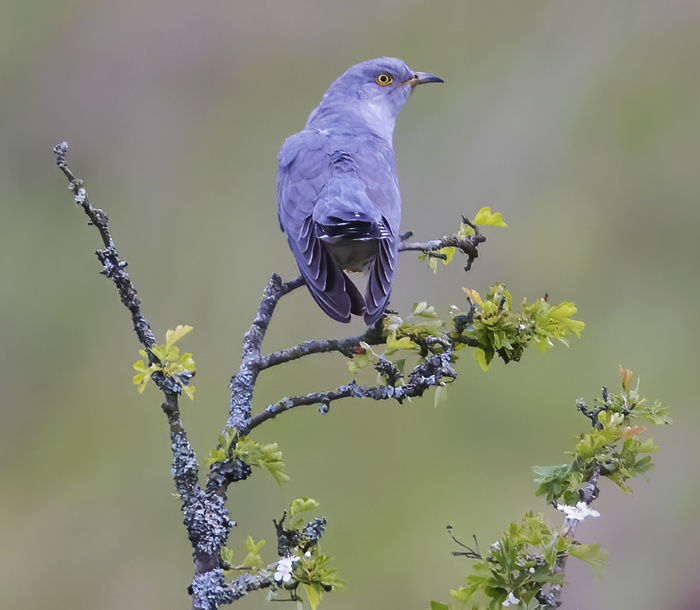
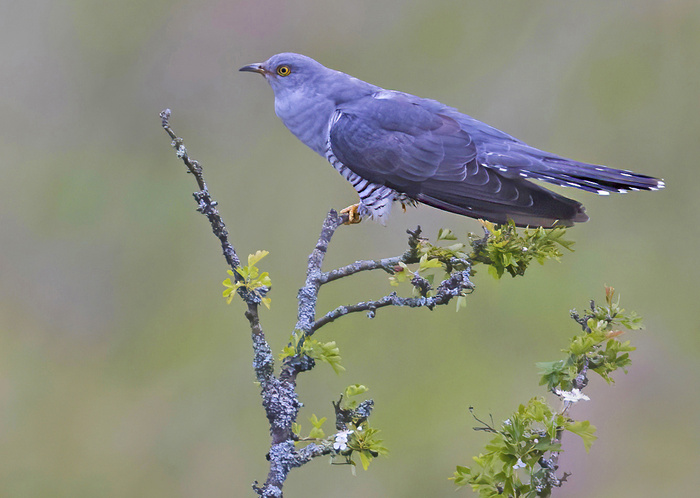
He didn’t stay long though before he was driven off by his pursuers.
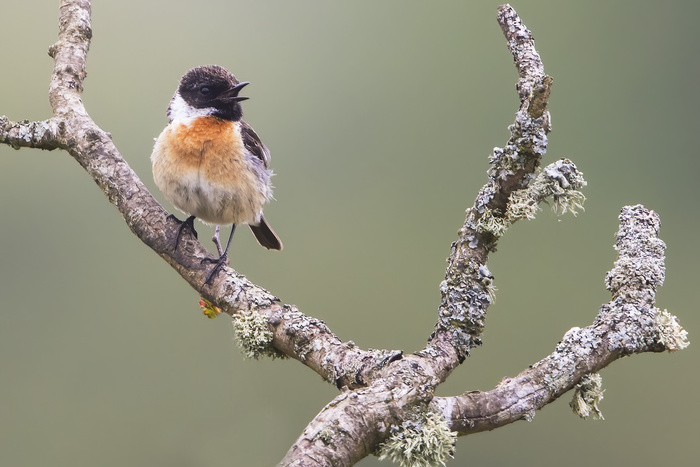
In a small bare bush next door a Stonechat perched and sung for a few minutes – pretty birds.
The Cuckoo flew past a few more times with a string of small birds in close pursuit, reminiscent of a child’s kite with tail streamers. Then surprisingly he just landed in the middle of a small Holly tree quite close to me, obviously fed up with the annoying small birds.
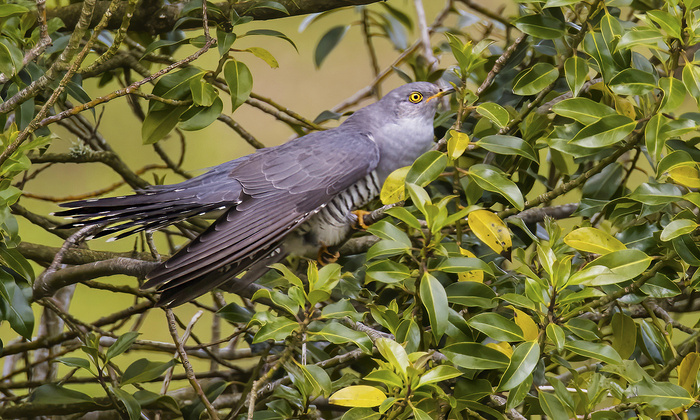
I quickly shot him before he was driven off again, which indeed wasn’t long.
As predicted rain had now began to fall, so I quickly pulled the 'Camo' netting off my vehicle, packed my kit away and reversed back up the hillside. It was now nine o’clock and I made my way back home in the ever increasing rain, time to call it a day.
I knew what area this Cuckoo was frequenting because I had been watching him from the road a couple of days previous. After parking underneath a substantial tree to break up my outline I draped a very big piece of ‘Camo’ net right over my vehicle and sat inside with my Canon 600 f4 on a beanbag on the door with the lens poking out. This is a location where it’s not possible to get really close to the birds because the ground drops away quite steeply and it would be easy to have an accident like rolling over, which I most certainly do not want!
The light started to build but it was slow because of the cloud cover. I had some coffee and just sat there waiting – at least I was in comfort, feeling warm and not worried about any potential rain. I could hear him calling now, they’re always about early, and then the daily routine of the Cuckoo begins – being harassed by a plethora of small birds eager to drive him away from their nesting area. It was seven o’clock before I first saw him as he perched on the top of one of the trees I had been watching – creatures of habit!
I took a few shots and I knew realistically that this was as close as I was going to get because of the aforementioned geography.
He didn’t stay long though before he was driven off by his pursuers.
In a small bare bush next door a Stonechat perched and sung for a few minutes – pretty birds.
The Cuckoo flew past a few more times with a string of small birds in close pursuit, reminiscent of a child’s kite with tail streamers. Then surprisingly he just landed in the middle of a small Holly tree quite close to me, obviously fed up with the annoying small birds.
I quickly shot him before he was driven off again, which indeed wasn’t long.
As predicted rain had now began to fall, so I quickly pulled the 'Camo' netting off my vehicle, packed my kit away and reversed back up the hillside. It was now nine o’clock and I made my way back home in the ever increasing rain, time to call it a day.
Common Whitethroat.
30th May 2024
30th May 2024
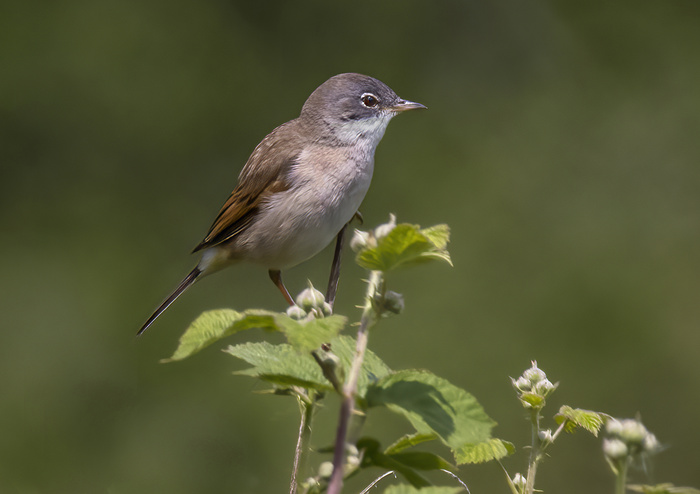
Foliage is growing fast now and finding, and for me photographing birds is becoming increasingly more difficult. Walking alongside a local lake margin I could hear Willow Warbler, Chiffchaff, Common Redstart and both Reed and Sedge Warblers, but none were visible. Further along I came across an overgrown bramble patch which is always an environment birds seem to like and sure enough I could hear Common Whitethroat singing. These little warblers are not easy to photograph because they can be quite shy and uncooperative. They hide in dense undergrowth most of the time, but with patience a birder/photographer can get some views as they pop up and sing briefly from a twig or small branch.
I waited for some time missing a couple of brief appearances before I finally managed to lock the focus on and catch it perched on a dead twig. It’s a bit awkward capturing these but with patience…..
 ]
I waited for some time missing a couple of brief appearances before I finally managed to lock the focus on and catch it perched on a dead twig. It’s a bit awkward capturing these but with patience…..
]
It's tough out there!
23rd May 2024
23rd May 2024
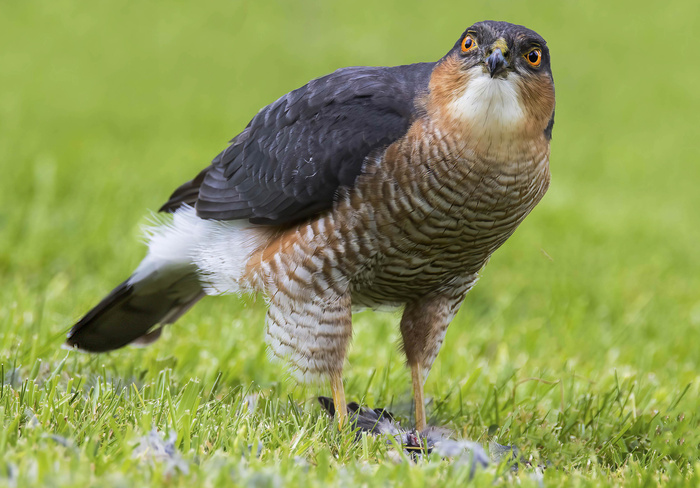
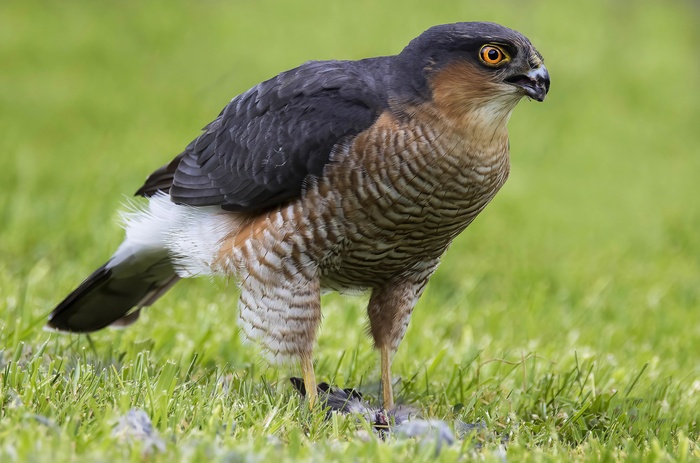
The male Sparrowhawk is a truly stunning bird and we are fortunate to have a mature bird visiting our garden, albeit infrequently. The small birds in the garden are not so fortunate though, as what looked like a Goldfinch, found out earlier today. Mercifully for the Goldfinch it was all over in a split second, but I’m afraid it’s a price they pay for persistently feeding out in the open. The other garden birds eat seed and then immediately retreat to cover.
The deep colour of this male bird shows his maturity – it's tough out there!!
https://youtu.be/j-IwEWjE_xs
The deep colour of this male bird shows his maturity – it's tough out there!!
https://youtu.be/j-IwEWjE_xs
Cuckoo diaries.
21st May 2024
21st May 2024
Cuckoos are enigmatic, period! That’s why it feels so satisfying when you get one in front of your lens. There’s always a sense of satisfaction about capturing such an awkward subject. To compound the issue females are far less photographed than males, almost all the images you see are of male birds and this is because a lot of people (photographers) know the males call but they don’t know the females call, and therefore they don’t realise they are there. The females call is totally different, a lot quieter and therefore far less carrying.
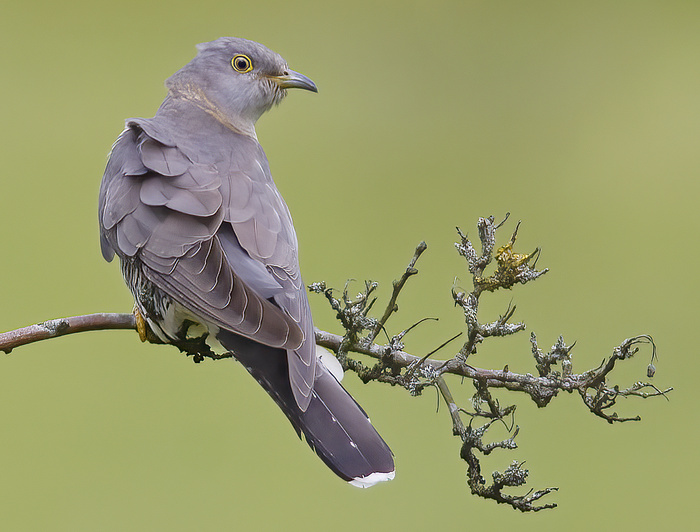
They say that every picture tells a story and the image below of a female has a story;
First story;
I was sat in my portable hide on a warm June day waiting for some Cuckoos I had been watching to hopefully perch in the bushes opposite. I was quite tired because I had been up early and to be truthful I was drifting in and out of sleep. Sitting in a comfortable chair in a hide with little happening can be quite soporific.
I had obviously drifted off because when I woke up I was looking up at the canvas roof of my hide. I quickly orientated myself and reached down for my flask of coffee and after pouring a cup I settled back into my vigil. However, I didn’t realise what had happened while I was asleep, because after about thirty seconds I could, unbelievably, see a Cuckoo perched in front of me and a female at that, staring over her shoulder right at me. She obviously knew there was something different nearby by the suspicious look on her face, but she couldn’t make out what it was.
I very slowly put my coffee cup into the dedicated cup holder in the arm of the chair in my hide and panned my lens extremely carefully until it was pointing at her. I fired the shutter and realised that most fortunately I had captured the image. She didn’t stay long after and I never saw her again.
That’s sometimes the pure luck of wildlife photography!!
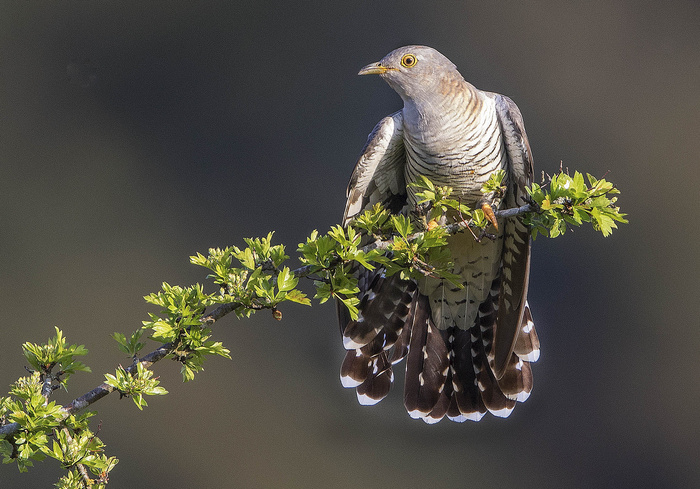
One thing you will always see with female Cuckoos is their rufous neck and collar. Apart from their overall rusty colouration these areas are where the colour seems to be concentrated. Both male and female Cuckoos also have ten tail feathers which they frequently splay, as you can see in this image.
Second story;
A male bird I had been watching for a week was proving to be extremely wary and unapproachable. I had been at a particular site before daylight on a couple of occasions and I had been undercover and totally hidden near to what I had assessed was his favourite perch – Cuckoos are very faithful to particular perches and sooner or later they will return there. As the hours literally turned into days this bird was proving to be the exception, he wouldn’t return to this perch no matter what. I had a theory that he recognized my car, which was parked a couple of hundred yards away, as being something alien which he didn’t like.
Another morning I was walking across a very boggy area to where this perch was and my welly just sunk into the bog and I couldn’t remove it. I had to pull my leg out and stand in the wet bog in my sock – not pleasant! Fortunately I always keep a spare pair of socks in the boot of my car, so after extricating my welly, with huge difficulty, I returned to the car re-dressed and started back again, taking care to avoid the same wet area of bog.
I resumed my position under cover and waited, he started calling again, or more accurately taunting (you can’t get me ‘Woo Hoo’). I waited and waited but no luck, I abandoned to rethink my strategy.
The following day I decided to get deeper into the copse of trees to try and view ‘His perch’ from a different angle, this time there was no photography involved. I rigged up a very large ‘Camo net’ across some bushes with a hole cut in it which looked straight at the perch, some forty feet away.
The following morning I was back there in the dark, I parked my car further away up the road, (probably bordering on being neurotic), but I wasn’t taking any chances, I was not going to be seen. I settled down in the copse, sitting on my stool with sandwiches and coffee, no hide this time just Camo. My lens was pointing at one thing, his perch. I was in such a position that I couldn’t move to photograph anything else even if I wanted to.
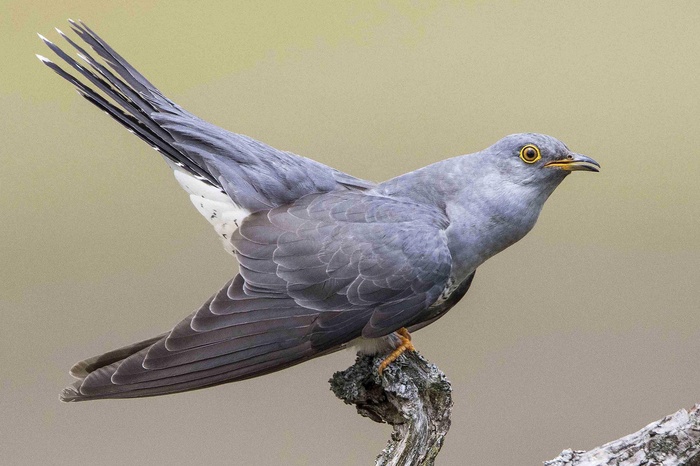
Then he started again Cuckoo, Cuckoo, and then his usual flying around. He perched in the high trees above me just as before, this time though I was confident he didn’t know I was there. I could hear him making his usual noises that all Cuckoos make, gasps, croaks etc. Ten minutes passed and there was no movement, now I was beginning to doubt my covert activities had indeed been as successful as I thought. Then there was a lovely moment, he just fluttered down like some giant butterfly onto his perch, and this time he was caught in the trap, I didn’t move, I didn’t have to because I had an IR remote shutter release on my camera, the shutter fired and I had him. It was such a nice feeling to finally overcome an inordinately crafty opponent.
These stories exemplify that sometimes it’s just pure luck, but with others it’s a product of hard work, field craft and perseverance.
They say that every picture tells a story and the image below of a female has a story;
First story;
I was sat in my portable hide on a warm June day waiting for some Cuckoos I had been watching to hopefully perch in the bushes opposite. I was quite tired because I had been up early and to be truthful I was drifting in and out of sleep. Sitting in a comfortable chair in a hide with little happening can be quite soporific.
I had obviously drifted off because when I woke up I was looking up at the canvas roof of my hide. I quickly orientated myself and reached down for my flask of coffee and after pouring a cup I settled back into my vigil. However, I didn’t realise what had happened while I was asleep, because after about thirty seconds I could, unbelievably, see a Cuckoo perched in front of me and a female at that, staring over her shoulder right at me. She obviously knew there was something different nearby by the suspicious look on her face, but she couldn’t make out what it was.
I very slowly put my coffee cup into the dedicated cup holder in the arm of the chair in my hide and panned my lens extremely carefully until it was pointing at her. I fired the shutter and realised that most fortunately I had captured the image. She didn’t stay long after and I never saw her again.
That’s sometimes the pure luck of wildlife photography!!
One thing you will always see with female Cuckoos is their rufous neck and collar. Apart from their overall rusty colouration these areas are where the colour seems to be concentrated. Both male and female Cuckoos also have ten tail feathers which they frequently splay, as you can see in this image.
Second story;
A male bird I had been watching for a week was proving to be extremely wary and unapproachable. I had been at a particular site before daylight on a couple of occasions and I had been undercover and totally hidden near to what I had assessed was his favourite perch – Cuckoos are very faithful to particular perches and sooner or later they will return there. As the hours literally turned into days this bird was proving to be the exception, he wouldn’t return to this perch no matter what. I had a theory that he recognized my car, which was parked a couple of hundred yards away, as being something alien which he didn’t like.
Another morning I was walking across a very boggy area to where this perch was and my welly just sunk into the bog and I couldn’t remove it. I had to pull my leg out and stand in the wet bog in my sock – not pleasant! Fortunately I always keep a spare pair of socks in the boot of my car, so after extricating my welly, with huge difficulty, I returned to the car re-dressed and started back again, taking care to avoid the same wet area of bog.
I resumed my position under cover and waited, he started calling again, or more accurately taunting (you can’t get me ‘Woo Hoo’). I waited and waited but no luck, I abandoned to rethink my strategy.
The following day I decided to get deeper into the copse of trees to try and view ‘His perch’ from a different angle, this time there was no photography involved. I rigged up a very large ‘Camo net’ across some bushes with a hole cut in it which looked straight at the perch, some forty feet away.
The following morning I was back there in the dark, I parked my car further away up the road, (probably bordering on being neurotic), but I wasn’t taking any chances, I was not going to be seen. I settled down in the copse, sitting on my stool with sandwiches and coffee, no hide this time just Camo. My lens was pointing at one thing, his perch. I was in such a position that I couldn’t move to photograph anything else even if I wanted to.
Then he started again Cuckoo, Cuckoo, and then his usual flying around. He perched in the high trees above me just as before, this time though I was confident he didn’t know I was there. I could hear him making his usual noises that all Cuckoos make, gasps, croaks etc. Ten minutes passed and there was no movement, now I was beginning to doubt my covert activities had indeed been as successful as I thought. Then there was a lovely moment, he just fluttered down like some giant butterfly onto his perch, and this time he was caught in the trap, I didn’t move, I didn’t have to because I had an IR remote shutter release on my camera, the shutter fired and I had him. It was such a nice feeling to finally overcome an inordinately crafty opponent.
These stories exemplify that sometimes it’s just pure luck, but with others it’s a product of hard work, field craft and perseverance.
Coffee, Biscuits and a Yellowhammer.
09th May 2024
09th May 2024
Out walking again on a local hillside on another glorious spring morning, bees hummed from the hedgerows as I walked along and as the foliage thinned out Willow Warblers sang from seemingly every other bush. Further on the faint song of a Curlew drifted past, carried on the light warm breeze while Ravens ‘Pronked’ from on high. A very distant Cuckoo, the herald of spring, called from further up the valley. What a lovely place to spend time.
I sat down on a conveniently large flat stone, and while pouring a cup of coffee an Orange Tip butterfly busied past, no doubt searching for some garlic mustard. I was just enjoying this lovely scene sipping my coffee and nibbling some shortbread biscuits (a kind and thoughtful present to us from earlier this week).
However, there was about to be another present as a Yellowhammer came into view on a grassy mound just above me, I quickly got my 100-500 lens out of the bag and as he got to the top, in a very favourable position, I shot him.
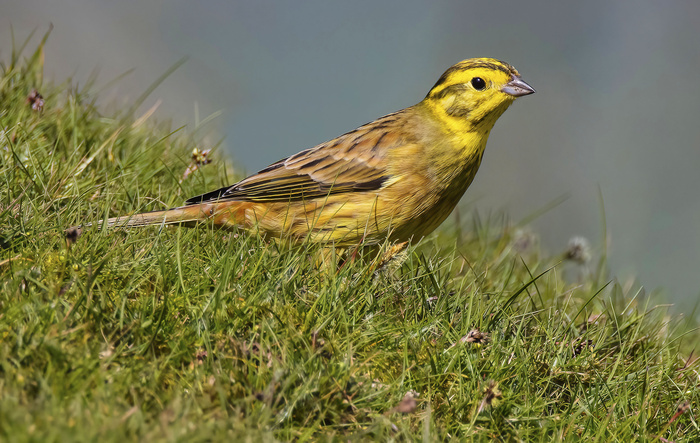
These are lovely birds which in the past were very common on most farmland, sadly these days not so common or widespread.
A very nice end to the morning.
I sat down on a conveniently large flat stone, and while pouring a cup of coffee an Orange Tip butterfly busied past, no doubt searching for some garlic mustard. I was just enjoying this lovely scene sipping my coffee and nibbling some shortbread biscuits (a kind and thoughtful present to us from earlier this week).
However, there was about to be another present as a Yellowhammer came into view on a grassy mound just above me, I quickly got my 100-500 lens out of the bag and as he got to the top, in a very favourable position, I shot him.
These are lovely birds which in the past were very common on most farmland, sadly these days not so common or widespread.
A very nice end to the morning.
Spring morning walk on a local hill.
07th May 2024
07th May 2024
Very pleasant to be out walking on a fine spring morning today, the woods were alive with Wood Warblers, one of my favourite spring migrants. I love their ‘Spinning Coin’ song and their sharp ‘Peep Peep’ call. There are such a pristine looking bird - snowy white below and lemon and olive above.
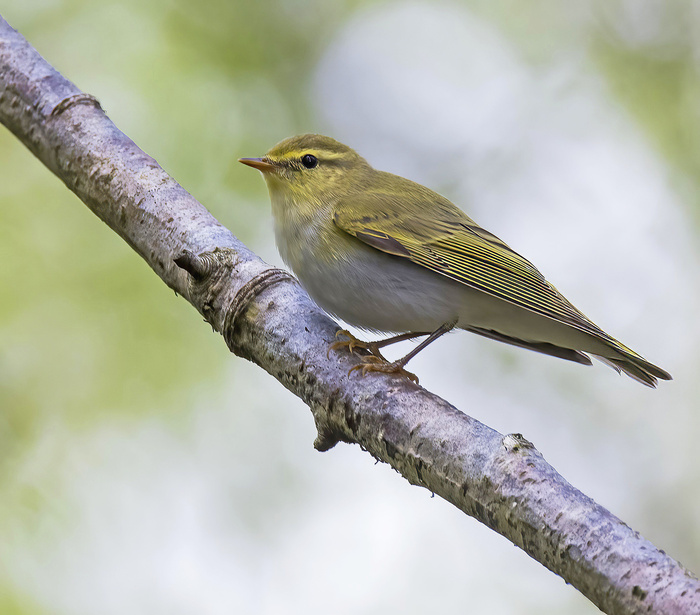
It was a pleasure to walk through there.
Then at the end of the woods and out onto the open hill a Cuckoo called, my first this spring. He was flying around from tree to tree so I tucked in underneath some Birch trees and when he landed in a tree nearby I shot him – not close really but OK for a record shot.
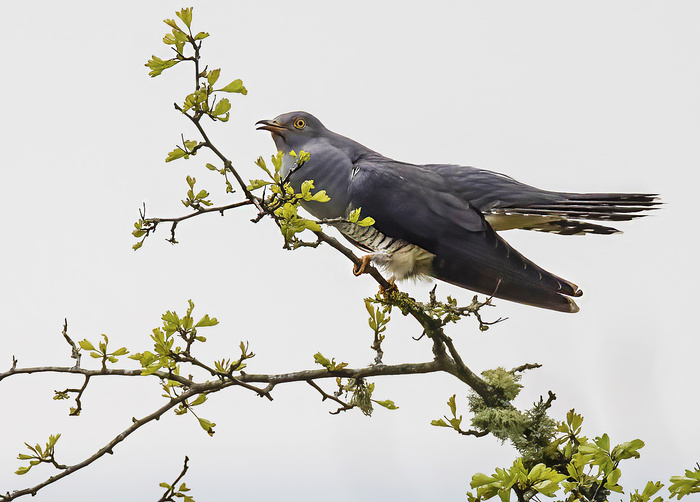
I hope to get closer later this month, but you never can tell, so I took this opportunity when it came.
A very pleasant couple of hours and two of my favourite birds as a bonus – I’ll take that anytime!
It was a pleasure to walk through there.
Then at the end of the woods and out onto the open hill a Cuckoo called, my first this spring. He was flying around from tree to tree so I tucked in underneath some Birch trees and when he landed in a tree nearby I shot him – not close really but OK for a record shot.
I hope to get closer later this month, but you never can tell, so I took this opportunity when it came.
A very pleasant couple of hours and two of my favourite birds as a bonus – I’ll take that anytime!
Ring Ouzel -The Mountain Blackbird.
27th April 2024
27th April 2024
The shy and difficult to approach Ring Ouzel is a favourite bird of mine. I have made no secret in previous blog posts of my admiration for these lovely birds. I am attracted to them because of the lonely, remote and difficult habitats they occupy. They are a bird of the high mountains, shunning the lower grasslands which would probably be more food laden and definitely more hospitable. They build their nests high up in the rocky gullies and boulder-clad hillsides of the Brecon Beacons. Their diet is virtually the same as the Blackbird, worms, beetles and other small animals in spring and summer, then changing to berries, notably Rowan, in the autumn, when on their southerly passage to their wintering grounds in Southern Spain and North Africa.
These birds are in serious decline as a breeding bird in the UK so in the spring you must treat their breeding grounds with respect. Do not approach birds that are alarm calling because that will mean they probably have a nest nearby.
With this in mind I decided to walk the higher Beacons yesterday to see if I could at least see one of these elusive birds. I started my ascent through the lower slopes with Willow Warblers singing frequently and as I climbed higher Stonechats started to appear. Two young Japanese tourists I passed on the way up were shod in lightweight canvas shoes, (which looked new) and were wearing just a thin top. This is totally inadequate for walking in the mountains, even in spring, but I see it so often. It’s OK if nothing happens, like the weather doesn’t deteriorate or you don’t step into cold wet mud or water or slip because of the lack of tread on your footwear. People dressed like this illustrate perfectly the reason why the mountain rescue service is kept so busy these days.
I pushed on finally reaching the top of the ridge, a cold brisk wind prevailed so I put another layer on under my jacket. I strapped my Canon R5 and RF 100-500 lens with a 1.4 teleconverter attached over my shoulder just in case I saw something. This gives me 1120mm of reach (500x1.6x1.4) but remains a very compact, lightweight and super sharp set up. I couldn’t even contemplate carrying my 600mm prime lens with a tripod and gimbal head up these slopes, it’s just too heavy and very awkward to set up in the wind - it’s asking for problems.
I walked along across the top of the ridge when suddenly a Ring Ouzel appeared on a fence post above me.
I was really surprised, I didn’t expect this, but I shot it immediately, however, I knew it wouldn’t be a good shot because there was a white background behind the bird because I was below it. It quickly disappeared though and I couldn’t see it after I had walked a little higher – I walked on. On a dry stone wall a Northern Wheatear flitted along in front of me, keeping its distance as I walked. High above a Peregrine Falcon swept across the sky and disappeared very quickly indeed. Ravens played on the wind, flying upside down at times, as they like to do for no other reason I assume than for fun.
I had now reached what I considered to be prime Ring Ouzel Habitat and I sat down in the heather for some respite from the wind. This heather is like a good quality mattress on a bed, it’s so comfortable you sink down into it almost like its been sprung. I was looking across at the top of a rock with a grassy mound above it, my gear was nestled in the heather by my side, a few spots of rain blew in on the wind but I was confident they were not going to come to anything. I poured myself a welcome cup of coffee and settled down on my very comfortable natural bedding. After a few minutes I thought I could hear a Ring Ouzel’s song, borne on the wind, I wasn’t sure but I’ve heard them singing enough times over the years to be put on alert. I was looking down into the valley some three hundred feet below and I could hear people’s voices, sound carries such a long distance, especially if the wind is in the right direction. The song became louder and now I was sure it was a Ring Ouzel, that lonely and evocative high pitched whistle which fits so perfectly into these remote surroundings. I looked left and unbelievably there it was, not fifteen yards away, sat on that grassy mound, one of my favourite birds – the elusive Ring Ouzel.
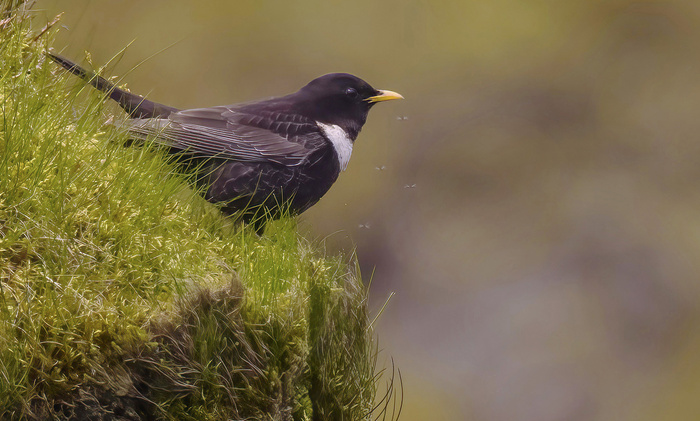
I gently lowered my coffee cup, picked up my gear and photographed him, it’s a lovely feeling when your lens focusses on your subject and I never get tired of it. There was no shutter noise to disturb him, a great feature of mirrorless cameras. I sat there in the heather with this elusive bird for twenty minutes as his gentle song drifted out into the valley and was then lost on the wind.
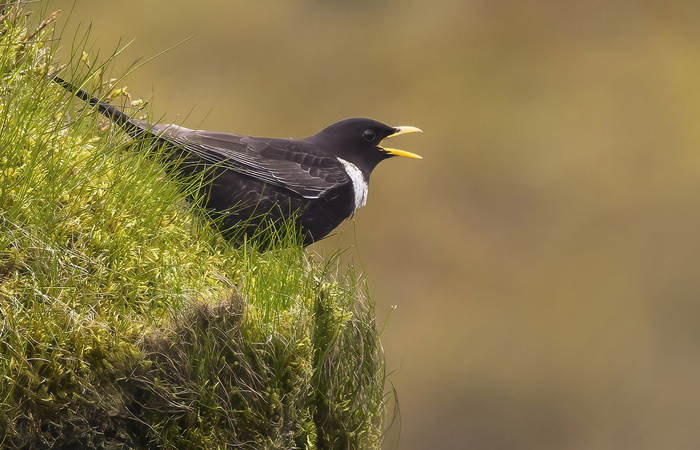
He seemed completely at ease with me and I cherish these little cameos because they may never happen again, these really are special birds.
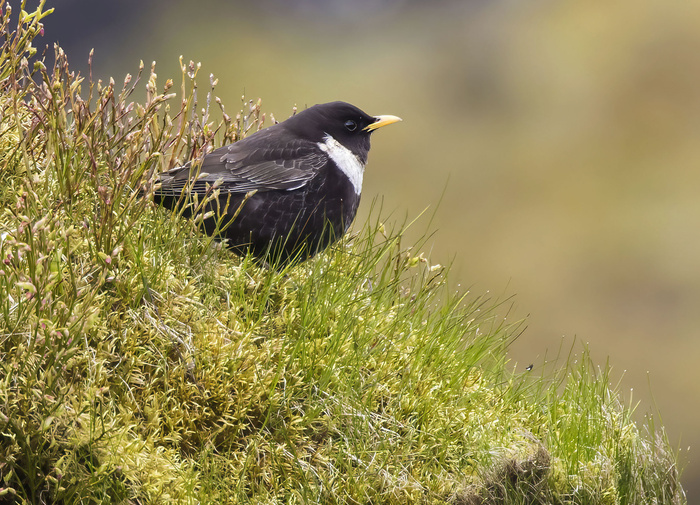
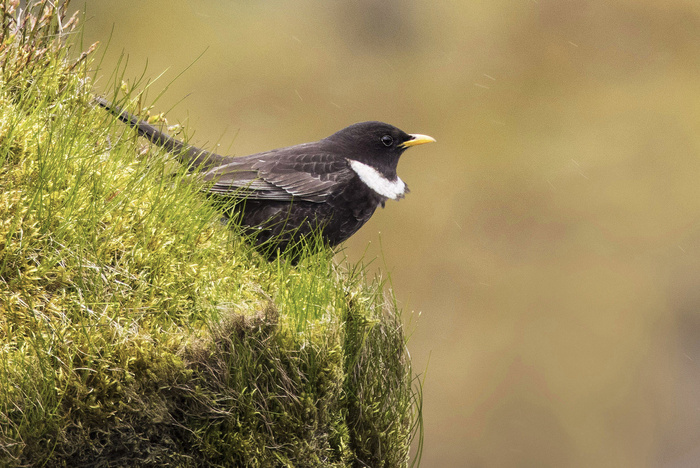
Then, inevitably he just flew away, lost from sight and I decided it was time for me to go, because after sitting still for half an hour that mouintain chill was starting to embrace me.
I picked my way carefully down the mountain and after a hundred or so feet I could again hear a Ring Ouzel singing, I stopped to listen and it appeared to be coming from just below me. I carefully slid down the heather, peering over and yes there it was, another male bird singing.
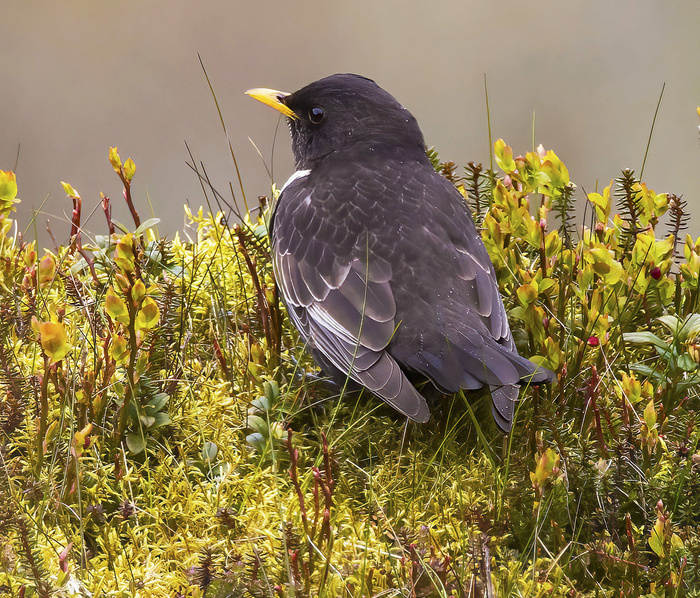
He couldn’t see me because he was looking out over the rocks. I managed to just about get him in the frame, difficult because of the foliage this time, before he too flew away. This had turned into a special day and I happily descended down the rest of the mountain back to my vehicle.
https://youtu.be/k1FMtpBY5Yc
These birds are in serious decline as a breeding bird in the UK so in the spring you must treat their breeding grounds with respect. Do not approach birds that are alarm calling because that will mean they probably have a nest nearby.
With this in mind I decided to walk the higher Beacons yesterday to see if I could at least see one of these elusive birds. I started my ascent through the lower slopes with Willow Warblers singing frequently and as I climbed higher Stonechats started to appear. Two young Japanese tourists I passed on the way up were shod in lightweight canvas shoes, (which looked new) and were wearing just a thin top. This is totally inadequate for walking in the mountains, even in spring, but I see it so often. It’s OK if nothing happens, like the weather doesn’t deteriorate or you don’t step into cold wet mud or water or slip because of the lack of tread on your footwear. People dressed like this illustrate perfectly the reason why the mountain rescue service is kept so busy these days.
I pushed on finally reaching the top of the ridge, a cold brisk wind prevailed so I put another layer on under my jacket. I strapped my Canon R5 and RF 100-500 lens with a 1.4 teleconverter attached over my shoulder just in case I saw something. This gives me 1120mm of reach (500x1.6x1.4) but remains a very compact, lightweight and super sharp set up. I couldn’t even contemplate carrying my 600mm prime lens with a tripod and gimbal head up these slopes, it’s just too heavy and very awkward to set up in the wind - it’s asking for problems.
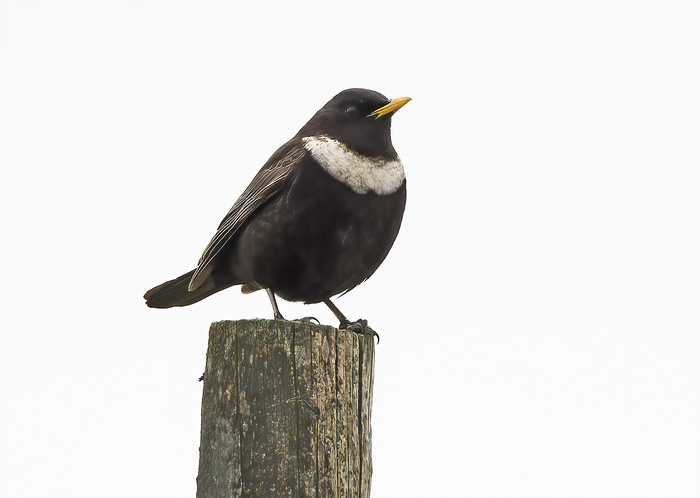
I walked along across the top of the ridge when suddenly a Ring Ouzel appeared on a fence post above me.
I was really surprised, I didn’t expect this, but I shot it immediately, however, I knew it wouldn’t be a good shot because there was a white background behind the bird because I was below it. It quickly disappeared though and I couldn’t see it after I had walked a little higher – I walked on. On a dry stone wall a Northern Wheatear flitted along in front of me, keeping its distance as I walked. High above a Peregrine Falcon swept across the sky and disappeared very quickly indeed. Ravens played on the wind, flying upside down at times, as they like to do for no other reason I assume than for fun.
I had now reached what I considered to be prime Ring Ouzel Habitat and I sat down in the heather for some respite from the wind. This heather is like a good quality mattress on a bed, it’s so comfortable you sink down into it almost like its been sprung. I was looking across at the top of a rock with a grassy mound above it, my gear was nestled in the heather by my side, a few spots of rain blew in on the wind but I was confident they were not going to come to anything. I poured myself a welcome cup of coffee and settled down on my very comfortable natural bedding. After a few minutes I thought I could hear a Ring Ouzel’s song, borne on the wind, I wasn’t sure but I’ve heard them singing enough times over the years to be put on alert. I was looking down into the valley some three hundred feet below and I could hear people’s voices, sound carries such a long distance, especially if the wind is in the right direction. The song became louder and now I was sure it was a Ring Ouzel, that lonely and evocative high pitched whistle which fits so perfectly into these remote surroundings. I looked left and unbelievably there it was, not fifteen yards away, sat on that grassy mound, one of my favourite birds – the elusive Ring Ouzel.
I gently lowered my coffee cup, picked up my gear and photographed him, it’s a lovely feeling when your lens focusses on your subject and I never get tired of it. There was no shutter noise to disturb him, a great feature of mirrorless cameras. I sat there in the heather with this elusive bird for twenty minutes as his gentle song drifted out into the valley and was then lost on the wind.
He seemed completely at ease with me and I cherish these little cameos because they may never happen again, these really are special birds.
Then, inevitably he just flew away, lost from sight and I decided it was time for me to go, because after sitting still for half an hour that mouintain chill was starting to embrace me.
I picked my way carefully down the mountain and after a hundred or so feet I could again hear a Ring Ouzel singing, I stopped to listen and it appeared to be coming from just below me. I carefully slid down the heather, peering over and yes there it was, another male bird singing.
He couldn’t see me because he was looking out over the rocks. I managed to just about get him in the frame, difficult because of the foliage this time, before he too flew away. This had turned into a special day and I happily descended down the rest of the mountain back to my vehicle.
https://youtu.be/k1FMtpBY5Yc
Skylark.
24th April 2024
24th April 2024
The Skylark’s song is heard by everybody who visits the uplands of the Brecon Beacons in spring and summer. They sing busily as they rise up, and then from the zenith and finally as they parachute back down to earth. This little bird’s song is an iconic and integral sound woven into our summers, be it a picnic, a horse ride, a game of golf, or just simply a walk, they provide the backdrop. Their song enhances a summer’s day, and albeit unwittingly sometimes, uplifts us.
So the next time you hear bird song from up high as you walk along on a sunny day, think of the Skylark, they may not be as colourful as some birds but they have a place in our psyche which is far more important.
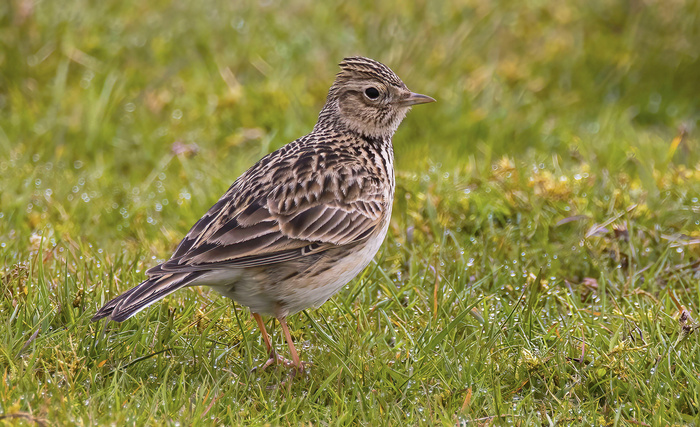
As I walked this morning in typical Skylark habitat I could hear their flight songs and also their calling to each other. They were feeding on the dew covered grass, looking for insects, a nice sight indeed.
So the next time you hear bird song from up high as you walk along on a sunny day, think of the Skylark, they may not be as colourful as some birds but they have a place in our psyche which is far more important.
As I walked this morning in typical Skylark habitat I could hear their flight songs and also their calling to each other. They were feeding on the dew covered grass, looking for insects, a nice sight indeed.
Pied Flycatcher.
22nd April 2024
22nd April 2024
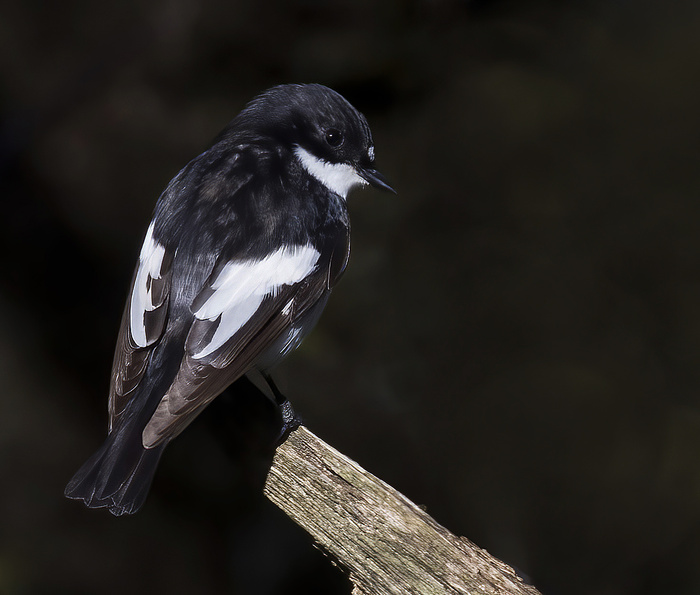
A quintessential spring migrant to Welsh deciduous woodlands is the Pied Flycatcher. These diminutive birds arrive in April and readily take to manufactured nest boxes in addition to their natural nesting spaces. They flit from tree to tree seeking out food in addition to dextrously plucking insects from the air. Susan and I visited a typical habitat for these birds last week on a beautiful Spring morning and managed to see and photograph a male.
They really are a lovely little bird.
They really are a lovely little bird.