News
Happy Xmas and New Year.
15th December 2013
15th December 2013
It’s that time of year again, it doesn’t feel like another year has passed, but here we are with Xmas almost upon us once again.
As Ebenezer Scrooge would say, in A Xmas Carol by Charles Dickens ”Another year older and not a penny richer“.
From a financial point of view, for most of us that is probably correct. However, from an ornithological standing it has been a very good year. The wonderful summer we have had this year has allowed birds to breed and to raise their young in relatively stable conditions. The highlight for me was being able to photograph Water Rails with their young, a once in a lifetime opportunity. This summer weather has also provided a super abundance of fruit for our winter visitors and residents. I hope that this year will go some way to repairing the damage previous poor summers and bitterly cold winters have had on bird populations.
After this glorious summer had ended and the Autumn bird passage arrived, if someone had told me I was going to photograph, Pectoral Sandpiper, Long Billed Dowitcher, Penduline Tit, Ring Ouzels, Northern Grey Shrike and Desert Wheatear I would have laughed at them. This unpredictability, however, is what I love about nature watching, you can go for long periods without seeing anything and you can’t imagine where the next image is coming from. Then suddenly right out of the blue there it is right in front of you!!
I hope that we have a reasonable coming winter, we are approaching the shortest day of the year and the weather is unseasonably mild, so far this is very good news for our wildlife.
This website’s statistics march inexorably onward towards the half million mark, something else I would have laughed at when I initiated it in 2010. I would genuinely like to thank everyone who visits these pages; it is most encouraging.
It’s just left for me to wish everyone a Happy Xmas and a bird filled 2014.
Steve.
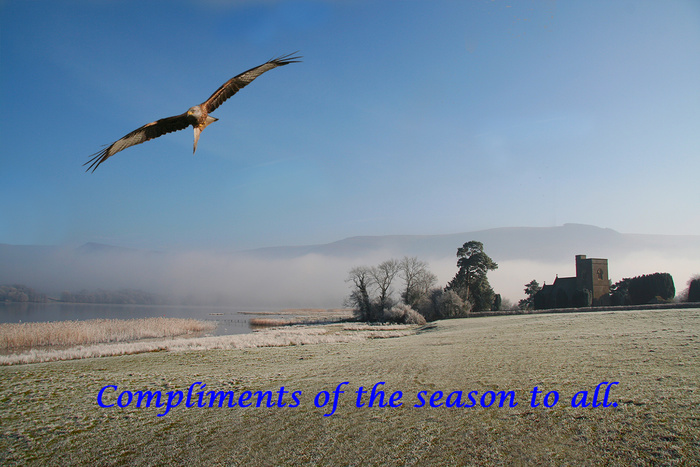
A Red Kite hunts over a misty Llangasty Church, on the shore of Llangors Lake.
Red Kite taken with a Canon ef 600 f4.0 L.
Church and Meadow taken with a Canon ef 17-40 f4.0 L.
As Ebenezer Scrooge would say, in A Xmas Carol by Charles Dickens ”Another year older and not a penny richer“.
From a financial point of view, for most of us that is probably correct. However, from an ornithological standing it has been a very good year. The wonderful summer we have had this year has allowed birds to breed and to raise their young in relatively stable conditions. The highlight for me was being able to photograph Water Rails with their young, a once in a lifetime opportunity. This summer weather has also provided a super abundance of fruit for our winter visitors and residents. I hope that this year will go some way to repairing the damage previous poor summers and bitterly cold winters have had on bird populations.
After this glorious summer had ended and the Autumn bird passage arrived, if someone had told me I was going to photograph, Pectoral Sandpiper, Long Billed Dowitcher, Penduline Tit, Ring Ouzels, Northern Grey Shrike and Desert Wheatear I would have laughed at them. This unpredictability, however, is what I love about nature watching, you can go for long periods without seeing anything and you can’t imagine where the next image is coming from. Then suddenly right out of the blue there it is right in front of you!!
I hope that we have a reasonable coming winter, we are approaching the shortest day of the year and the weather is unseasonably mild, so far this is very good news for our wildlife.
This website’s statistics march inexorably onward towards the half million mark, something else I would have laughed at when I initiated it in 2010. I would genuinely like to thank everyone who visits these pages; it is most encouraging.
It’s just left for me to wish everyone a Happy Xmas and a bird filled 2014.
Steve.
A Red Kite hunts over a misty Llangasty Church, on the shore of Llangors Lake.
Red Kite taken with a Canon ef 600 f4.0 L.
Church and Meadow taken with a Canon ef 17-40 f4.0 L.
Desert Wheatear
15th December 2013
15th December 2013
A first winter male Desert Wheatear has been hanging around the seafront of Severn Beach village near the new Severn bridge for a few days. It was seen by two people who didn't know what it was so they contacted a local birder and told him that they had seen a 'Wheatear-like bird'. On investigation he was surprised to find a Desert Wheatear feeding among the detritus on the beach.
Normally found in North Africa where they inhabit stony ground with scattered vegetation, just outside of the really sandy areas of desert. They are a short distance migrant usually just moving further south in winter, so what this bird is doing on a stony beach in Gloucestershire in December is anybody's guess. It has moved in the opposite direction to its usual migration pattern, probably blown northwards by the strong southerly winds we have been experiencing.
I have seen many of these lovely birds in Morocco but I was still keen to see another one, especially so close to home.
I traveled down on Saturday to see it and I was amazed to find it such a confiding bird, it had no fear of people whatsoever and at one stage was within six feet of the assembled birdwatchers. It wasn't a challenge to photograph so I just took a few shots and enjoyed the spectacle it provided. People concerned by reports of its welfare had been feeding it meal worms and it had also been observed eating earwigs, it spent a few periods of time just keeping still, probably stuffed by all the food on offer.
What a lovely little bird to see, an early Xmas present.
Please see Rare Birds, Desert Wheatear.
Normally found in North Africa where they inhabit stony ground with scattered vegetation, just outside of the really sandy areas of desert. They are a short distance migrant usually just moving further south in winter, so what this bird is doing on a stony beach in Gloucestershire in December is anybody's guess. It has moved in the opposite direction to its usual migration pattern, probably blown northwards by the strong southerly winds we have been experiencing.
I have seen many of these lovely birds in Morocco but I was still keen to see another one, especially so close to home.
I traveled down on Saturday to see it and I was amazed to find it such a confiding bird, it had no fear of people whatsoever and at one stage was within six feet of the assembled birdwatchers. It wasn't a challenge to photograph so I just took a few shots and enjoyed the spectacle it provided. People concerned by reports of its welfare had been feeding it meal worms and it had also been observed eating earwigs, it spent a few periods of time just keeping still, probably stuffed by all the food on offer.
What a lovely little bird to see, an early Xmas present.
Please see Rare Birds, Desert Wheatear.
Monmouthshire and Brecon Canal.
24th November 2013
24th November 2013
The Monmouthshire and Brecon canal runs from its basin right outside the Theatre Brycheiniog in the centre of Brecon, through a few small local villages and on to its termination outside the market town of Abergavenny.
I have walked along this canal for nearly forty years and I have watched its popularity grow as more and more people hire boats and barges for holidays and also cycle and walk its length. This popularity bears no resemblance to how I remember the canal all those years ago. While I was looking at the lock keepers house yesterday I was thinking about old Tom who used to live there. He was a real old character, he used to ride his battered old bike along the canal footpath most evenings to enjoy a few pints in the White Hart in Talybont on Usk. He used to tell great stories, of which I couldn’t get enough. Mike the landlord, known as ‘Mike the White’ wouldn’t have a television or juke box in his pub, he said they ruined conversation! He did, however, have live music there some nights, no amps, just a guitar or banjo and a singalong. I particularly remember one night when a blind gentleman was led in and sat down with a pint, suddenly a guitar was produced and this man sang and played one of the most beautiful renditions of 'Unchained Melody' by the Righteous Brothers I have ever heard. Mike, who never displayed much emotion retreated to the kitchen and later reappeared with tears running down his face declaring that he had been peeling onions for a stew he was making, however, we all knew the real reason for his tears. Another time Screaming Lord Such of Monster Raving Looney Party fame stayed the night at the pub during one of his political campaigns. After his dinner he retired to his room and the following morning Mike knocked on his bedroom door to tell him breakfast was ready, only to find that he had disappeared in the night without paying his bill.
What great times we had there!!
Sadly both Mike and Tom passed away many years ago, and the pub, just like many others now, no individuality.....
I digress;
The deciduous trees which line the canal banks are particularly beautiful for a short period this time of year as their leaves change to a myriad of different colours. There is a small window of time when a photographer can capture these colours. A bright sunny day with blue sky is needed, a lack of people and before the first heavy frosts cause the leaves to drop. I have invested in a new wide angled lens and I thought I would give it a test run. I will detail my impression of it in the equipment review section on the front page of this site.
Meanwhile, please see Landscapes, Around the local area, Mon and Brecon Canal.
I have walked along this canal for nearly forty years and I have watched its popularity grow as more and more people hire boats and barges for holidays and also cycle and walk its length. This popularity bears no resemblance to how I remember the canal all those years ago. While I was looking at the lock keepers house yesterday I was thinking about old Tom who used to live there. He was a real old character, he used to ride his battered old bike along the canal footpath most evenings to enjoy a few pints in the White Hart in Talybont on Usk. He used to tell great stories, of which I couldn’t get enough. Mike the landlord, known as ‘Mike the White’ wouldn’t have a television or juke box in his pub, he said they ruined conversation! He did, however, have live music there some nights, no amps, just a guitar or banjo and a singalong. I particularly remember one night when a blind gentleman was led in and sat down with a pint, suddenly a guitar was produced and this man sang and played one of the most beautiful renditions of 'Unchained Melody' by the Righteous Brothers I have ever heard. Mike, who never displayed much emotion retreated to the kitchen and later reappeared with tears running down his face declaring that he had been peeling onions for a stew he was making, however, we all knew the real reason for his tears. Another time Screaming Lord Such of Monster Raving Looney Party fame stayed the night at the pub during one of his political campaigns. After his dinner he retired to his room and the following morning Mike knocked on his bedroom door to tell him breakfast was ready, only to find that he had disappeared in the night without paying his bill.
What great times we had there!!
Sadly both Mike and Tom passed away many years ago, and the pub, just like many others now, no individuality.....
I digress;
The deciduous trees which line the canal banks are particularly beautiful for a short period this time of year as their leaves change to a myriad of different colours. There is a small window of time when a photographer can capture these colours. A bright sunny day with blue sky is needed, a lack of people and before the first heavy frosts cause the leaves to drop. I have invested in a new wide angled lens and I thought I would give it a test run. I will detail my impression of it in the equipment review section on the front page of this site.
Meanwhile, please see Landscapes, Around the local area, Mon and Brecon Canal.
Arctic winds and Two Barred Crossbills.
17th November 2013
17th November 2013
We are set for the first real cold spell of the winter next week with Arctic winds blowing and some snow falling on high ground. Heavy frosts are also predicted so a combination of these winds and frosts should finally remove the last lingering leaves from the trees. Hopefully this weather will also push Bramblings south to this area, time to increase the feeding programme in my garden. There are about twenty migrant Blackbirds around my garden as I write, feeding on fallen apples and Cotoneaster berries.
Waxwings are in Derby today (30), I don't think we'll see any here this year, but I hope I'm wrong.
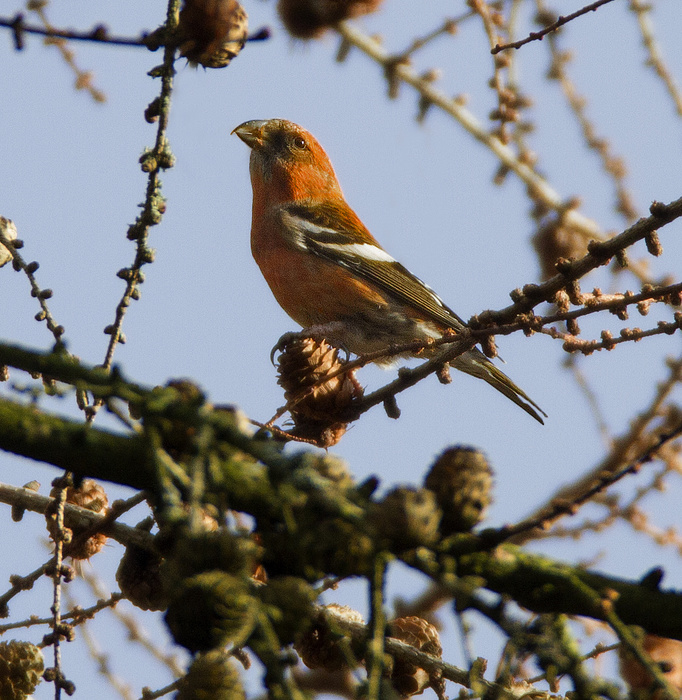
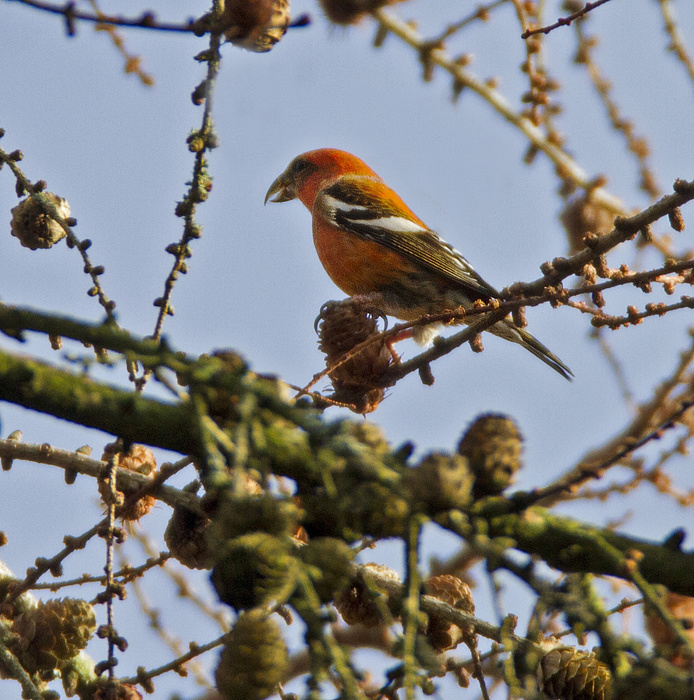
This year has seen a remarkable movement of Two Barred Crossbills into the UK and a double figure flock are currently in the Forest of Dean near Speech House. I managed to see a flock of betweem four and six birds flying and briefly perching in Hemlock trees at this location. However, I was lucky to see them at all because the noise that some people make is hard to credit, how they ever expect to see anything amazes me. One man was talking so loudly I could hear what he was saying twenty yards away. Some time later he was 'talking' on his mobile phone and I use the term talking in the loosest sense, because the person he was talking to could probably have heard him without the phone!. Another group were laughing and talking really loudly and paying no attention to the birds flying around the tree tops. Later on I was standing just waiting to see if anything would fly or perch near to a small pond, when I could hear a group of people coming from approximately 100yds away laughing and shouting, ironically when they appeared they were all three dressed in Camo clothing, what a joke! they haven't got the first clue about watching nature. A number of people had travelled long distances to see, what are after all, very rare birds in the UK. Lee Evans (Twitcher) stood next to me was getting really frustrated with all the noise and for once I had to agree with him.
These Crossbills have irrupted in numbers,( 50,000 ) being reported moving from Siberian forests into Scandinavia and some of these have subsequently been seen in various areas of the UK over the last couple of months. They are usually very rare in the UK and these current numbers are unprecedented. They make quite distinctive 'Trumpet' like sounds during their call and song, unlike our common Crossbill and they have as their name indicates two large white wing bars.
Well worth keeping an eye out for in local conifer plantations!
Waxwings are in Derby today (30), I don't think we'll see any here this year, but I hope I'm wrong.
This year has seen a remarkable movement of Two Barred Crossbills into the UK and a double figure flock are currently in the Forest of Dean near Speech House. I managed to see a flock of betweem four and six birds flying and briefly perching in Hemlock trees at this location. However, I was lucky to see them at all because the noise that some people make is hard to credit, how they ever expect to see anything amazes me. One man was talking so loudly I could hear what he was saying twenty yards away. Some time later he was 'talking' on his mobile phone and I use the term talking in the loosest sense, because the person he was talking to could probably have heard him without the phone!. Another group were laughing and talking really loudly and paying no attention to the birds flying around the tree tops. Later on I was standing just waiting to see if anything would fly or perch near to a small pond, when I could hear a group of people coming from approximately 100yds away laughing and shouting, ironically when they appeared they were all three dressed in Camo clothing, what a joke! they haven't got the first clue about watching nature. A number of people had travelled long distances to see, what are after all, very rare birds in the UK. Lee Evans (Twitcher) stood next to me was getting really frustrated with all the noise and for once I had to agree with him.
These Crossbills have irrupted in numbers,( 50,000 ) being reported moving from Siberian forests into Scandinavia and some of these have subsequently been seen in various areas of the UK over the last couple of months. They are usually very rare in the UK and these current numbers are unprecedented. They make quite distinctive 'Trumpet' like sounds during their call and song, unlike our common Crossbill and they have as their name indicates two large white wing bars.
Well worth keeping an eye out for in local conifer plantations!
Penduline Tit.
10th November 2013
10th November 2013
When news broke of a male Penduline Tit showing at Uskmouth nature reserve near Newport I couldn't decide whether to go or not. These are beautiful little birds and quite rare in the UK and although their range is spreading, unless you are prepared to go to one of the Kent reserves, Dungeness or Stodmarsh you are not going to see one. With this in mind I decided to try my luck and I left early Saturday morning in the pouring rain. The weather forecast was, however, predicting sunny spells later in the morning.
I arrived at the reserve in the rain and there were about fifteen birders there, the bird had called but had not been seen. I waited outside the reserve centre for about an hour before the bird flew over us and dropped down into the reed bed, I didn't have a view so I decided to walk away to the side of the reed bed and just wait. The rain had eased considerably by now and blue sky was breaking through. Shortly after the bird started to feed on the bull rushes, vigorously pulling them apart searching for seeds. The reed mace started off looking like a large sausage but by the time the bird had finished it looked like a candy floss.
This lovely little bird put on a great show, mostly being obscured by the reeds but from time to time showing right out in the open. The crowd had grown rapidly to about fifty and it was then I decided there was too much noise and movement, so I called it a day, being quite contented with the shots I had managed.
There was a report later that the bird had flown away from the reed bed, so I'm glad I decided to go early and not leave it until Sunday when the weather forecast was much more favourable.
Please see Rare Birds, Penduline Tit.
I arrived at the reserve in the rain and there were about fifteen birders there, the bird had called but had not been seen. I waited outside the reserve centre for about an hour before the bird flew over us and dropped down into the reed bed, I didn't have a view so I decided to walk away to the side of the reed bed and just wait. The rain had eased considerably by now and blue sky was breaking through. Shortly after the bird started to feed on the bull rushes, vigorously pulling them apart searching for seeds. The reed mace started off looking like a large sausage but by the time the bird had finished it looked like a candy floss.
This lovely little bird put on a great show, mostly being obscured by the reeds but from time to time showing right out in the open. The crowd had grown rapidly to about fifty and it was then I decided there was too much noise and movement, so I called it a day, being quite contented with the shots I had managed.
There was a report later that the bird had flown away from the reed bed, so I'm glad I decided to go early and not leave it until Sunday when the weather forecast was much more favourable.
Please see Rare Birds, Penduline Tit.
Northern Grey Shrike.
07th November 2013
07th November 2013
A wintering Northern Grey Shrike has returned to an upland area near Brecon. It's lovely to see this bird back again, I wonder where he's been? I would love to have seen him on his travels. After Tuesday's report by two top local patch workers I was itching to see him. However, yesterday's weather was dreadful and as a result I was penned in, but today I was there early to try and see him. I was lucky to see him almost as I arrived, there was nobody around and the bird was relaxed, he doesn't like people so you have to get there early. I managed to shoot him perched on a fence post as I hid behind a large gorse bush. It really is very nice to see this bird again, I hope he has a pleasant and safe winter here!
I have subsequently photographed him in various locations.
Please see Uk Birds, Cuckoos, Shrikes and Waxwings, Northern Grey Shrike.
I have subsequently photographed him in various locations.
Please see Uk Birds, Cuckoos, Shrikes and Waxwings, Northern Grey Shrike.
Ring Ouzel Autumn passage 2013.
31st October 2013
31st October 2013
At last the Ring Ouzels are on return passage from Scandinavia, they have appeared at a traditional site this week. I was there at first light this morning to try and see these lovely but very shy birds.
Out of interest the female bird at the top of the Rowan looking left is the same bird that is in the middle of the Rowan in another image. Both marked (1). It is quite remarkable what tricks light can play, the bird in the middle of the tree appears much darker, but look at the blemishes below its left eye and they are exactly the same in both images!
I'm sure many darker females get mistaken for males, but the males, as shown in the images on the site, are a much more sooty black with a snowy white crescent with no mottling on it. Females are not sooty black, they are varying colours, from a greyish black to a chocolate brown and they have a duller more mottled crescent.
Sometimes they are not so straight forward as they seem!
I am no expert by any means but this is the only criteria I can use with any confidence.
Please see UK Birds, Ring Ouzels.
Out of interest the female bird at the top of the Rowan looking left is the same bird that is in the middle of the Rowan in another image. Both marked (1). It is quite remarkable what tricks light can play, the bird in the middle of the tree appears much darker, but look at the blemishes below its left eye and they are exactly the same in both images!
I'm sure many darker females get mistaken for males, but the males, as shown in the images on the site, are a much more sooty black with a snowy white crescent with no mottling on it. Females are not sooty black, they are varying colours, from a greyish black to a chocolate brown and they have a duller more mottled crescent.
Sometimes they are not so straight forward as they seem!
I am no expert by any means but this is the only criteria I can use with any confidence.
Please see UK Birds, Ring Ouzels.
Registered with the Fat Birder site.
28th October 2013
28th October 2013
I thought I'd see how this site stacks up against the myriad of bird sites out there. I started out at 1072 yesterday and today I am at 977, so slowly creeping up the list. The counter on the home page reflects the traffic viewing the site compared to the other registered sites and it increases or decreases accordingly. I just wonder what position It would be in if the 379,000 hits it had accumalated before I registered had been calculated.
Just a bit of fun, as long as the site is enjoyed that's all that counts for me.
Just a bit of fun, as long as the site is enjoyed that's all that counts for me.
Who'd be a twitcher ?
25th October 2013
25th October 2013
This Autumn has again seen a run of rare birds on the Shetland Isles. The term 'MEGA' is used to describe these rarities and the latest is a Cape May Warbler. These rarities must be an absolute nightmare for the 'Twitching' fraternity, trying to assess whether the bird will stay or go. The last Cape May Warbler was seen in the UK in 1977, so unless you were around the twitching scene then you potentially have a very long, stressful and expensive journey ahead of you. This latest rarity is on Unst, Shetland, the most northerly inhabited island in the UK. Just getting there is a nightmare, once landing on the Shetland mainland, possibly after a twelve hour ferry crossing from Aberdeen or an expensive charter flight, you then have to Island hop by ferry to get to Unst. Such is the priority placed on seeing this bird by many 'listers', they are prepared to pay for a charter flight onto the unmanned airstrip on Unst, a flight and landing only for the most hardy of individuals. I have been fortunate to see these birds in Cape May near New Jersey in America and although, like this individual they were in Autumn plumage, they are still a very attractive bird. That is, however, of no consequence to the 'twitcher', it is only a bonus, 'ticking' this bird is all that matters.
The weather on Unst has been horrendous this week with gale force winds and horizontal rain, but the bird is staying put. This will be a great relief to many 'listers' because there may not be another one in their lifetime.
I wish them luck!
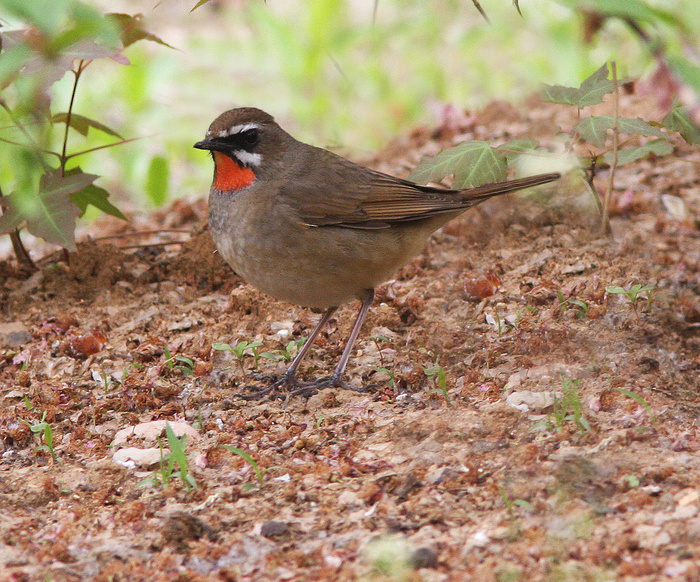
Earlier this week there was another 'MEGA' on the Shetland Isles. This time on Fair isle, a not so geographically challenging encounter as Unst, however, still a very long journey. This bird was a male Siberian Rubythroat, ( WOW!! even the name sounds just fantastic ). It is the 'Holy Grail' for birders, most of the previous records of these birds have been female, still an obvious 'MEGA' but not so prized as the male!
These birds have a history on the Shetlands of staying a few days and then leaving which means people have to 'Bite the Bullet' and react immediately if they want it. It is not such a priority as the Cape May Warbler because it is more likely to occur in the future and more people will have seen one of the previous half dozen or so that have made it to the UK. However, these male birds have an almost mythical status in the UK, most birders just see them as their dream bird. There is just something about them, they are a member of the Chat family, they are not the most colourful, although the male I think is a real 'Stonker' and they can be very skulking in their habits.
Again I was lucky to see one in China, the only one of my whole trip there. We were birding in the overgrown gardens of an abandoned hotel complex, which turned out to be a very good area for many rare Western Palearctic birds. We had seen some lovely rare thrushes, including Siberian, when a small bird emerged from the bushes behind me and It felt like I was in shock, a male Siberian Rubythroat, just looking at me from the leaf litter. I only had my Canon 300 with me because there was too much travelling about to lug a big lens around. I picked up the lens slowly, praying it wouldn't fly away and I managed a few shots before it disappeared back into the bushes never to be seen again! Another man standing behind me named John had openly stated that he was absolutely desparate to see one and I could hear him repeating to himself 'My God' over and over as if he couldn't believe what he had just seen.
To end this blog with a note of realism, which highlights the stressful life of 'Twitchers', a group privately chartered a plane to Fair Isle earlier this week at a cost of £600 each, in an attempt to see the Rubythroat, only to find on landing that it had gone..............
The weather on Unst has been horrendous this week with gale force winds and horizontal rain, but the bird is staying put. This will be a great relief to many 'listers' because there may not be another one in their lifetime.
I wish them luck!
Earlier this week there was another 'MEGA' on the Shetland Isles. This time on Fair isle, a not so geographically challenging encounter as Unst, however, still a very long journey. This bird was a male Siberian Rubythroat, ( WOW!! even the name sounds just fantastic ). It is the 'Holy Grail' for birders, most of the previous records of these birds have been female, still an obvious 'MEGA' but not so prized as the male!
These birds have a history on the Shetlands of staying a few days and then leaving which means people have to 'Bite the Bullet' and react immediately if they want it. It is not such a priority as the Cape May Warbler because it is more likely to occur in the future and more people will have seen one of the previous half dozen or so that have made it to the UK. However, these male birds have an almost mythical status in the UK, most birders just see them as their dream bird. There is just something about them, they are a member of the Chat family, they are not the most colourful, although the male I think is a real 'Stonker' and they can be very skulking in their habits.
Again I was lucky to see one in China, the only one of my whole trip there. We were birding in the overgrown gardens of an abandoned hotel complex, which turned out to be a very good area for many rare Western Palearctic birds. We had seen some lovely rare thrushes, including Siberian, when a small bird emerged from the bushes behind me and It felt like I was in shock, a male Siberian Rubythroat, just looking at me from the leaf litter. I only had my Canon 300 with me because there was too much travelling about to lug a big lens around. I picked up the lens slowly, praying it wouldn't fly away and I managed a few shots before it disappeared back into the bushes never to be seen again! Another man standing behind me named John had openly stated that he was absolutely desparate to see one and I could hear him repeating to himself 'My God' over and over as if he couldn't believe what he had just seen.
To end this blog with a note of realism, which highlights the stressful life of 'Twitchers', a group privately chartered a plane to Fair Isle earlier this week at a cost of £600 each, in an attempt to see the Rubythroat, only to find on landing that it had gone..............
Llangasty bird hide at Llangors Lake
22nd October 2013
22nd October 2013
This new bird hide was opened in March 2012, it supercedes the old hide which served the area well for many years and was still very useful. The old hide has been moved to nearby Talybont Reservoir where it remains to the present day.
This new hide was built in association with the Prince's Trust, employing young people from the scheme along with top quality trades people.
It is a wonder to behold, made from solid Oak which is furnished with hand forged latches and handles. The hide has a superbly laid thatched roof with a slate capping. It has two solid oak approach ways which are augmented by a high quality dry stone wall. The inside of the hide is light and airy and the centre piece is a beautifully crafted hand made semi circular stained glass window depicting the bird life of the lake.
On entering the hide through the church like door you get a distinct ecclesiastical feeling, with its vault like ceiling and stained glass window, it's like entering a mini cathedral.
Is is without doubt the most elaborate bird hide I have ever seen and is a credit to all involved.
Please see Landscapes, Around the local area, Llangasty bird hide.
This new hide was built in association with the Prince's Trust, employing young people from the scheme along with top quality trades people.
It is a wonder to behold, made from solid Oak which is furnished with hand forged latches and handles. The hide has a superbly laid thatched roof with a slate capping. It has two solid oak approach ways which are augmented by a high quality dry stone wall. The inside of the hide is light and airy and the centre piece is a beautifully crafted hand made semi circular stained glass window depicting the bird life of the lake.
On entering the hide through the church like door you get a distinct ecclesiastical feeling, with its vault like ceiling and stained glass window, it's like entering a mini cathedral.
Is is without doubt the most elaborate bird hide I have ever seen and is a credit to all involved.
Please see Landscapes, Around the local area, Llangasty bird hide.
Two ' Yanks ' in one week!!!
10th October 2013
10th October 2013
Two 'Yanks' in one week, I can barely believe it. After the Pectoral Sandpiper was discovered locally this week, hot on its heels comes a Long Billed Dowitcher. As soon as news broke, the following morning I went straight to the location. The bird was found on another pond about twenty miles away from where I live. This latest area is in an extremely bleak, post industrial landscape above the old Iron making town of Merthyr Tydfil. The pond and surrounding area are due to be totally destroyed by an open cast mining scheme which many people oppose. This may be a bleak location but it certainly turns up some great birds and it will be a great shame to lose it. This bird, like the Pectoral sandpiper, was quite confiding and it allowed close approach within reason.
Please see Rare Birds, Long Billed Dowitcher.
Please see Rare Birds, Long Billed Dowitcher.
Arctic winds on the way.
08th October 2013
08th October 2013
Strong cold winds from the north are on the way later this week, hopefully they will drive down returning migrants like Ring Ouzel. These winds may also encourage wintering Thrushes and Bramblings and dare I hope Waxwings, which are already in northern parts of the UK. There is a super abundance of berries in waiting which should sustain them for quite a while. I have never seen the Rowan, Hawthorn and Blackthorn trees so full of berries and there are apples everywhere. In addition the Oak and Beech trees are literally groaning with fruit after the perfect growing conditions of this past year.
Beech mast is a staple diet of Hawfinches during winter.
Lets hope for a good show from all these lovely birds this autumn and winter!
Beech mast is a staple diet of Hawfinches during winter.
Lets hope for a good show from all these lovely birds this autumn and winter!
Pectoral Sandpiper
07th October 2013
07th October 2013
There is a remote upland area of water and mud nearby named Brechfa Pool. It doesn't usually attract many birds, the odd Wader etc, but now and then something nice turns up and recently a Pectoral Sandpiper has taken up residence for a few days. There have been a few of these 'American' waders in the country recently and it's nice that we have had one here. It was an unusually confiding bird for a change, allowing very good views, sometimes this happens, who knows why? but I'm not complaining,
Please see UK Birds, Waders, Pectoral Sandpiper.
Please see UK Birds, Waders, Pectoral Sandpiper.
The Supernatural Nightjar
06th September 2013
06th September 2013
The Nightjar's scientific name of Caprimulgus means 'Goat Sucker'. This derives from bizarre ancient folklore that Nightjars had supernatural powers and at night stole the milk from the teats of goats. This belief came about because of the birds habit of lying near cattle and other animals. In reality the birds were waiting for insects that were drawn to the animals.
Other colloquial names for these mysterious birds refer to their odd appearance, call, habitat and diet. Just a few are: Nighthawk, Flying Toad, Fern Owl, Dorhawk, Moth Owl, Eve-Churr and Jar Owl.
On a warm summer's night, if they are lucky, a birdwatcher can hear the distant 'Churring' of the male as he becomes active right at the very last light of day. Then seemingly out of nowhere they appear and the males and females begin their hunt for large flying insects against the inky blue night sky. The Nightjar has a large gape with stiff whiskers at the corners so they can channel the insects into their mouths. They have an almost silent flight as they beat their wings like a giant nocturnal butterfly, it's little wonder that they have a mysterious reputation. They spend all day roosting low down on the forestry floor or sitting horizontally along branches. They are almost impossible to see because of their cryptic plumage and will only fly right at the last second if they are disturbed.
The male can be told from the female by his white wing patches, these can be seen as he flies around displaying to the female while loudly clapping his long wings.
They arrive sometime in May and can have two broods, normally two young in each, the young are out of the nest and independent within a month, the adult birds then migrate back to sub Saharan Africa in late August/early September, leaving the young birds to look after themselves. It is quite humbling to think that these young birds, who are only six weeks old and have never known anything but the 200 yards of forestry they were raised in, will during the next few weeks take on an epic flight all the way to Africa;
This summer I have had great views of both sexes and also the male displaying to the female, flying around and wing clapping right in front of me.
Last night I decided to have one more try at seeing them, I arrived just before dusk and decided to drive along the forest track where I had seen the adult birds previously. Young Nightjars do have a habit of sitting out on these forest tracks waiting for insects to fly over them. The light had rapidly faded and was now virtually pitch black, the only light available was very week moonlight, so I knew I had to be careful because young Nightjars don't 'Churr' they just make a faint squeak as they fly around.
I hadn't bothered bringing a big lens with me because it was a waste of time lugging it around in the dark and it is a recipe for an accident if ever there was one! I had dressed in some old clothes and I had a large 'Bean bag' in the boot along with my Canon 300mm f4.0 lens, I felt this lens was more manageable in those conditions.
As I turned a corner something caught my eye and I slowed right down to a crawl and on the track I could see two young Nightjars, I could barely believe it, a dream come true.
I inched closer until they were right in my headlights, then I quietly got out and opened the boot as slowly as I could and got my kit out. I snaked along the track, getting covered in stone dust and moss until I was only about fifteen feet from them. Amazingly they seemed completely unconcerned by me, I positioned my Bean bag and managed to take a few shots as they just sat there. One bird was swallowing a moth while the other was preening its feathers, they have a serrated middle claw which they use as a 'comb' for this purpose.
It really is very special to get that close to these elusive creatures of the night.
I moved back slowly and quietly reversed my car away and left them to their hunting and as I drove away I caught them again in my headlights flying around after their prey.
I have only spent two ten minute sessions with these young birds because I didn't want to disturb them. They need to feed and put on as much weight as they possibly can for their forthcoming journey, I really do hope they make it!!
What a fabulous bird they are.
Please see UK Birds, Nightjars
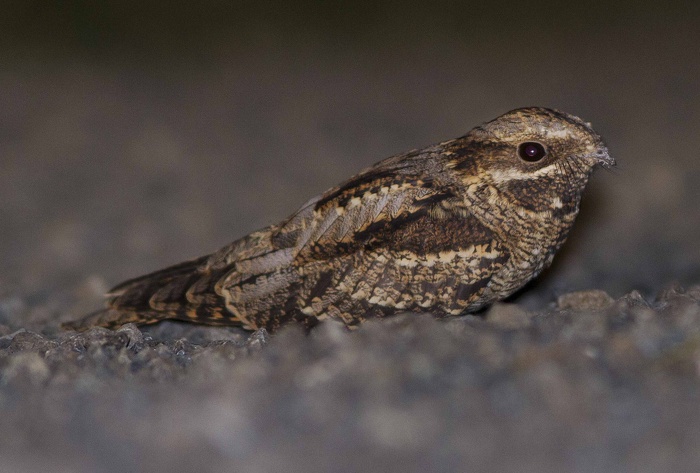
Other colloquial names for these mysterious birds refer to their odd appearance, call, habitat and diet. Just a few are: Nighthawk, Flying Toad, Fern Owl, Dorhawk, Moth Owl, Eve-Churr and Jar Owl.
On a warm summer's night, if they are lucky, a birdwatcher can hear the distant 'Churring' of the male as he becomes active right at the very last light of day. Then seemingly out of nowhere they appear and the males and females begin their hunt for large flying insects against the inky blue night sky. The Nightjar has a large gape with stiff whiskers at the corners so they can channel the insects into their mouths. They have an almost silent flight as they beat their wings like a giant nocturnal butterfly, it's little wonder that they have a mysterious reputation. They spend all day roosting low down on the forestry floor or sitting horizontally along branches. They are almost impossible to see because of their cryptic plumage and will only fly right at the last second if they are disturbed.
The male can be told from the female by his white wing patches, these can be seen as he flies around displaying to the female while loudly clapping his long wings.
They arrive sometime in May and can have two broods, normally two young in each, the young are out of the nest and independent within a month, the adult birds then migrate back to sub Saharan Africa in late August/early September, leaving the young birds to look after themselves. It is quite humbling to think that these young birds, who are only six weeks old and have never known anything but the 200 yards of forestry they were raised in, will during the next few weeks take on an epic flight all the way to Africa;
This summer I have had great views of both sexes and also the male displaying to the female, flying around and wing clapping right in front of me.
Last night I decided to have one more try at seeing them, I arrived just before dusk and decided to drive along the forest track where I had seen the adult birds previously. Young Nightjars do have a habit of sitting out on these forest tracks waiting for insects to fly over them. The light had rapidly faded and was now virtually pitch black, the only light available was very week moonlight, so I knew I had to be careful because young Nightjars don't 'Churr' they just make a faint squeak as they fly around.
I hadn't bothered bringing a big lens with me because it was a waste of time lugging it around in the dark and it is a recipe for an accident if ever there was one! I had dressed in some old clothes and I had a large 'Bean bag' in the boot along with my Canon 300mm f4.0 lens, I felt this lens was more manageable in those conditions.
As I turned a corner something caught my eye and I slowed right down to a crawl and on the track I could see two young Nightjars, I could barely believe it, a dream come true.
I inched closer until they were right in my headlights, then I quietly got out and opened the boot as slowly as I could and got my kit out. I snaked along the track, getting covered in stone dust and moss until I was only about fifteen feet from them. Amazingly they seemed completely unconcerned by me, I positioned my Bean bag and managed to take a few shots as they just sat there. One bird was swallowing a moth while the other was preening its feathers, they have a serrated middle claw which they use as a 'comb' for this purpose.
It really is very special to get that close to these elusive creatures of the night.
I moved back slowly and quietly reversed my car away and left them to their hunting and as I drove away I caught them again in my headlights flying around after their prey.
I have only spent two ten minute sessions with these young birds because I didn't want to disturb them. They need to feed and put on as much weight as they possibly can for their forthcoming journey, I really do hope they make it!!
What a fabulous bird they are.
Please see UK Birds, Nightjars
The secretive and elusive Water Rail.
01st August 2013
01st August 2013
The Water rails is a genuine oddity amongst British birds, with its pig-like squealing and other strange and eerie noises sometimes made through the night. It is also very unpredictable, because for a bird that can be so noisy it is notoriously reclusive, but it sometimes, although infrequently, can be seen right out in the open. Its slender legs and toes are adapted for walking on floating plants, allowing it to slip quickly through the marshy vegetation without being seen. Cold weather triggers predatory behaviour, which is out of character with its largely insectivorous lifestyle, and it has been known to attack species as large as knots.
On a local lake with very large reed beds I knew Water rails existed because I had often heard their pig-like squealing, however, over at least ten years I have only managed to photograph a bird once. I have often seen one scoot quickly across a gap between the reed beds but that was all.
Things are a little quiet on the bird front at the moment so one morning earlier this week I decided to get out early to try and photograph a family of Reed Warblers I had seen previously. I managed to get a few shots and I was just waiting for another opportunity when I could hear a call I didn't recognize, I thought it sounded like a young bird, Coot or Moorhen perhaps, but it just didn't sound right. I waited for a minute or two and to my surprise a Water rail walked out of the vegetation, then another, I shot them both and I thought 'what a stroke of luck, right place, right time I suppose'. However, what happened next was quite incredible, a little ball of black fluff with a creme coloured beak crept through the long grass. I could not believe what I was seeing, a Water rail chick, you just don't see these birds they are so secretive with their young.
On Spring Watch this year young Water rail chicks were filmed, for what was thought to be the first time in the nest, that's how elusive they are. This was for me the next best thing, just to see this one was a huge achievement, however, it wasn't finished there, not by a long shot, another, then another chick and in total five Water rail chicks, I really, really couldn't believe it now!!
I managed to take a few quick shots before they quickly disappeared into the reed bed, I thought 'Wow! did that really happen'. I was just getting used to what I had seen when I heard the same squeak. I pointed my lens to where I thought the noise had come from, it can be so difficult to pin point the exact area a noise comes from in a reed bed. It was, however, better to be proactive just in case they came out again, because if I had the lens pointing away the movement as the lens swung around may have frightened them away.
What happened next just freaked me out, the two adult birds led the five chicks right out into the open. Seven Water rails all running around in front of me, I didn't know where to look let alone take a photograph. I managed to compose myself as the adults started to probe the muddy bottom of the reed bed and then feed the chicks, the adults posed, then the chicks posed, then they posed together, what an experience.
I took a whole raft of shots during a 'golden' ten minute period, then they as a family, just melted away into the depths of the reed bed. I was left dumbfounded, all thoughts of Reed Warblers had disappeared, I packed up and left in a state of shock.
Please see UK Birds, Herons, Egrets and Rails, Water Rail.
On a local lake with very large reed beds I knew Water rails existed because I had often heard their pig-like squealing, however, over at least ten years I have only managed to photograph a bird once. I have often seen one scoot quickly across a gap between the reed beds but that was all.
Things are a little quiet on the bird front at the moment so one morning earlier this week I decided to get out early to try and photograph a family of Reed Warblers I had seen previously. I managed to get a few shots and I was just waiting for another opportunity when I could hear a call I didn't recognize, I thought it sounded like a young bird, Coot or Moorhen perhaps, but it just didn't sound right. I waited for a minute or two and to my surprise a Water rail walked out of the vegetation, then another, I shot them both and I thought 'what a stroke of luck, right place, right time I suppose'. However, what happened next was quite incredible, a little ball of black fluff with a creme coloured beak crept through the long grass. I could not believe what I was seeing, a Water rail chick, you just don't see these birds they are so secretive with their young.
On Spring Watch this year young Water rail chicks were filmed, for what was thought to be the first time in the nest, that's how elusive they are. This was for me the next best thing, just to see this one was a huge achievement, however, it wasn't finished there, not by a long shot, another, then another chick and in total five Water rail chicks, I really, really couldn't believe it now!!
I managed to take a few quick shots before they quickly disappeared into the reed bed, I thought 'Wow! did that really happen'. I was just getting used to what I had seen when I heard the same squeak. I pointed my lens to where I thought the noise had come from, it can be so difficult to pin point the exact area a noise comes from in a reed bed. It was, however, better to be proactive just in case they came out again, because if I had the lens pointing away the movement as the lens swung around may have frightened them away.
What happened next just freaked me out, the two adult birds led the five chicks right out into the open. Seven Water rails all running around in front of me, I didn't know where to look let alone take a photograph. I managed to compose myself as the adults started to probe the muddy bottom of the reed bed and then feed the chicks, the adults posed, then the chicks posed, then they posed together, what an experience.
I took a whole raft of shots during a 'golden' ten minute period, then they as a family, just melted away into the depths of the reed bed. I was left dumbfounded, all thoughts of Reed Warblers had disappeared, I packed up and left in a state of shock.
Please see UK Birds, Herons, Egrets and Rails, Water Rail.
Disaster in the Beacons
27th July 2013
27th July 2013
It is now confirmed that a major outbreak of Phytophthora Ramorum is present in the conifer plantations in the Talybont and Taf Fechan areas of the Brecon Beacons national park. This disease is affecting Larch trees badly, turning them brown and causing them to die back. Evidence of this can be seen from most elevated positions on the Beacons. A major tree felling exercise will soon begin on thousands of hectares of forestry in an attempt to stop this outbreak.
This is disastrous news for birds like Goshawk, Nightjar, Crossbill and Siskin. Each one of these birds depend on these plantations for their existence. Goshawks breed exclusively in these plantations, Crossbills breed there and their only source of food is pine cone seeds, Larch in particular. Siskins also feed and breed there and Nightjars, although they favour felled areas of conifer, next May 2014, when they arrive at their breeding sites they will be met by a massive logging operation with tree felling machinery and transporters.
It really couldn't have come at a worse time for birds, their numbers are already in decline and now this!!
Sad times.
This is disastrous news for birds like Goshawk, Nightjar, Crossbill and Siskin. Each one of these birds depend on these plantations for their existence. Goshawks breed exclusively in these plantations, Crossbills breed there and their only source of food is pine cone seeds, Larch in particular. Siskins also feed and breed there and Nightjars, although they favour felled areas of conifer, next May 2014, when they arrive at their breeding sites they will be met by a massive logging operation with tree felling machinery and transporters.
It really couldn't have come at a worse time for birds, their numbers are already in decline and now this!!
Sad times.
Little Owl and Photoshop Technique
23rd July 2013
23rd July 2013
Locally there are a pair of Little Owls that live in an almost dead, Ivy-clad Oak tree. Sometimes they will sit out and show well but usually they hide amongst the Ivy. This makes it very difficult to get an unobstructed image. The only solution is to take the best image you can and then attempt to remove some of the offending foliage. This is not easy and some images are unworkable and are made worse by over-processing and in these cases they are best left unprocessed.
However, this week I took a shot of one of the Owls that I felt I could do something with.
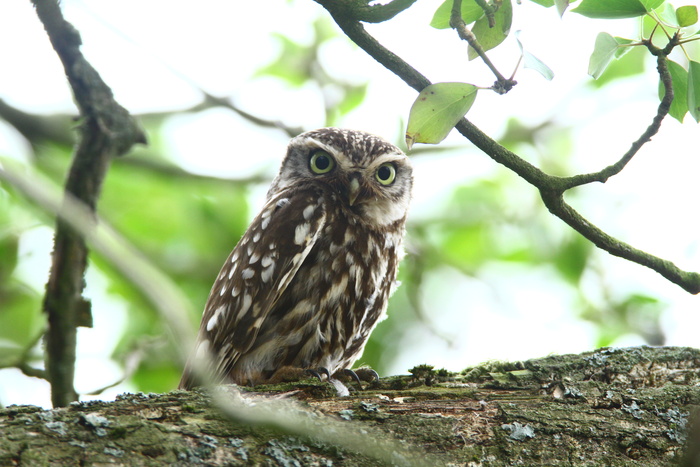
There are two obvious problems with this image: an Ivy leaf near the bird's head and a thin branch in the foreground running through the bird's tail and perch. Also there are numerous out of focus branches and leaves making a very cluttered background.
There are two options here - one is to use Photoshop to attempt to remove these obstructions, the other is to leave the image as a record shot.
I decided to try and remove the obstructions and improve the general image and background. The background of a photograph, I think, is at least as important as the subject and makes the overall image much more pleasing. A cluttered or badly contrasting background takes the viewer's eye away from the subject so I always try, where possible, to achieve a complimentary background. This is obviously something that needs great attention when you are taking the photograph because it can save you a lot of time and effort later on in post processing.
Some people may ' sniff ' at post processing but this is after all digital imaging and many a potentially good photograph has been unnecessarily consigned to the recycle bin.
The best way to remove unwanted clutter is to use the Quick Selection Tool in Photoshop which allows you to "ring fence" the subject whilst working outside on the obstructions.
1. I always attempt to remove the obstructions first before thinking about exposure, composition etc. If you can't remove the offenders there is no point in proceeding.
2. Isolate the subject first using the Quick Selection Tool, this is in the tools palette on the left side of the screen. You can increase or decrease the size of the brush as required and also increase or decrease the area to be "ring fenced" by using the plus and minus icons. It is best to 'tighten' the "ring fence" around the subject to avoid a 'halo' effect. This is done by clicking on select / modify then expand or contract. Then using the Clone Stamp Tool, (adjust the brush size as required). I attempted to follow the tail feathers over the branch that was obscuring part of the tail, taking great care to maintain feather lines and markings. In order to achieve any success here it is best to enlarge the image as much as 200% so a small area can be greatly magnified and then concentrated on.
3. Then reverse the Selection Tool by clicking select and then inverse, any work now done will be 'outside' the "ring fence". I then removed the branch obscuring the perch using the Clone Stamp Tool. I also removed the Ivy leaf and out of focus branches using the same procedure. Increase or decrease the brush size as appropriate. I left some green leaves that could be duplicated to form background colour also by using the Clone Stamp Tool.
4. I adjusted the background contrast and exposure without affecting the subject because I was working 'outside' the area "ring fenced".
5. I reversed the Selection Tool back again by clicking inverse so that I could work on the subject 'inside' the "ring fence". This is particularly useful for altering the contrast and sharpening etc, of a subject, without affecting the background, thereby avoiding the dreaded 'noise' which can make a background appear very 'grainy'.
6. Finally, I adjusted the image to size and saved under a different file name. It is always best to save your image after every procedure so that you can always return to the previous "platform" to start again if necessary.
This is the processed image, not perfect, but better than just a record shot.
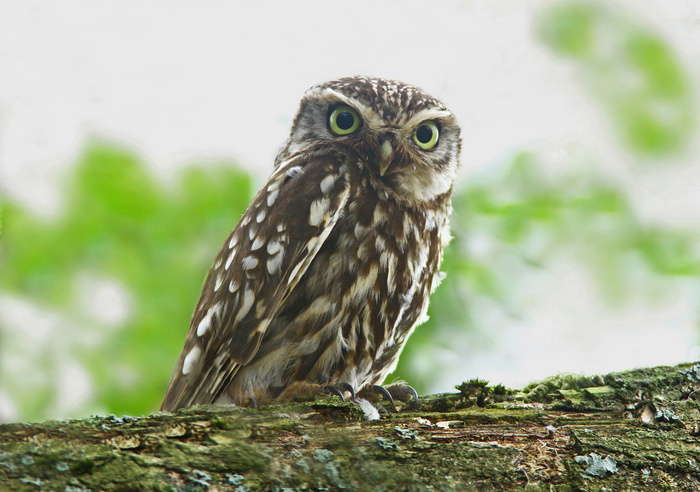
However, this week I took a shot of one of the Owls that I felt I could do something with.
There are two obvious problems with this image: an Ivy leaf near the bird's head and a thin branch in the foreground running through the bird's tail and perch. Also there are numerous out of focus branches and leaves making a very cluttered background.
There are two options here - one is to use Photoshop to attempt to remove these obstructions, the other is to leave the image as a record shot.
I decided to try and remove the obstructions and improve the general image and background. The background of a photograph, I think, is at least as important as the subject and makes the overall image much more pleasing. A cluttered or badly contrasting background takes the viewer's eye away from the subject so I always try, where possible, to achieve a complimentary background. This is obviously something that needs great attention when you are taking the photograph because it can save you a lot of time and effort later on in post processing.
Some people may ' sniff ' at post processing but this is after all digital imaging and many a potentially good photograph has been unnecessarily consigned to the recycle bin.
The best way to remove unwanted clutter is to use the Quick Selection Tool in Photoshop which allows you to "ring fence" the subject whilst working outside on the obstructions.
1. I always attempt to remove the obstructions first before thinking about exposure, composition etc. If you can't remove the offenders there is no point in proceeding.
2. Isolate the subject first using the Quick Selection Tool, this is in the tools palette on the left side of the screen. You can increase or decrease the size of the brush as required and also increase or decrease the area to be "ring fenced" by using the plus and minus icons. It is best to 'tighten' the "ring fence" around the subject to avoid a 'halo' effect. This is done by clicking on select / modify then expand or contract. Then using the Clone Stamp Tool, (adjust the brush size as required). I attempted to follow the tail feathers over the branch that was obscuring part of the tail, taking great care to maintain feather lines and markings. In order to achieve any success here it is best to enlarge the image as much as 200% so a small area can be greatly magnified and then concentrated on.
3. Then reverse the Selection Tool by clicking select and then inverse, any work now done will be 'outside' the "ring fence". I then removed the branch obscuring the perch using the Clone Stamp Tool. I also removed the Ivy leaf and out of focus branches using the same procedure. Increase or decrease the brush size as appropriate. I left some green leaves that could be duplicated to form background colour also by using the Clone Stamp Tool.
4. I adjusted the background contrast and exposure without affecting the subject because I was working 'outside' the area "ring fenced".
5. I reversed the Selection Tool back again by clicking inverse so that I could work on the subject 'inside' the "ring fence". This is particularly useful for altering the contrast and sharpening etc, of a subject, without affecting the background, thereby avoiding the dreaded 'noise' which can make a background appear very 'grainy'.
6. Finally, I adjusted the image to size and saved under a different file name. It is always best to save your image after every procedure so that you can always return to the previous "platform" to start again if necessary.
This is the processed image, not perfect, but better than just a record shot.
Breeding Lapwings
23rd July 2013
23rd July 2013
These lovely birds have suffered huge habitat loss over the last ten years causing a major decline in their numbers, so it is very pleasing to see my good neighbours, John and Ann Morgan at Middlewood Farm, Bwlch, going out of their way to create a wet habitat suitable for Lapwings to breed and successfully raise their young. All credit to them for this effort.
This is the third year that the Lapwings have bred successfully, this year raising three young.
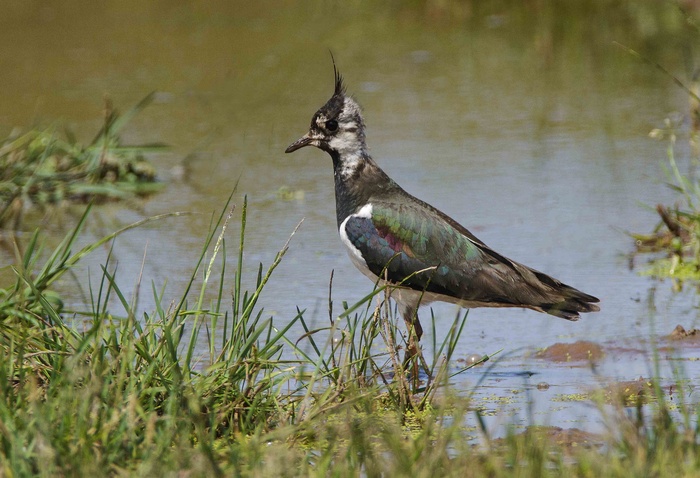
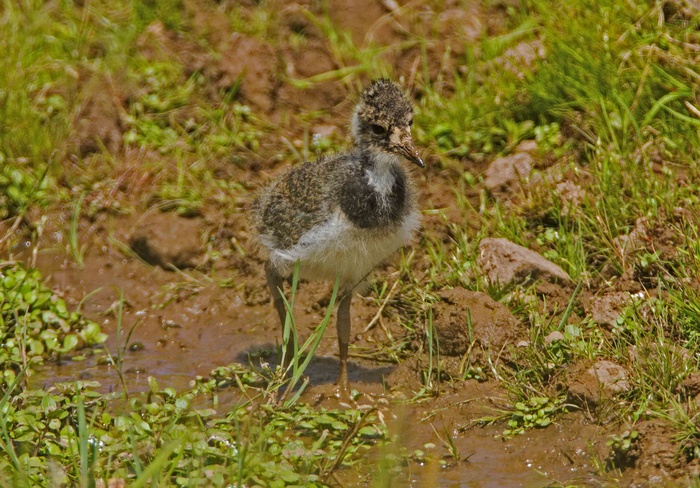
This is the third year that the Lapwings have bred successfully, this year raising three young.
Afon Tarell - Jewel of the Brecon Beacons
23rd July 2013
23rd July 2013
The first couple of miles of the Afon Tarell are through open moorland running over the red sandstone of the Brecon Beacons, however, as it descends into the Tarell valley the rock strata changes to limestone. It is from here that this beautiful and charismatic river becomes more secretive and inaccessible, racing through dense deciduous woodlands of Beech, Ash, Oak and Willow.
As it makes its way through this woodland the Afon Tarell bubbles over stretches of rocky, shallow riverbed where Dippers,
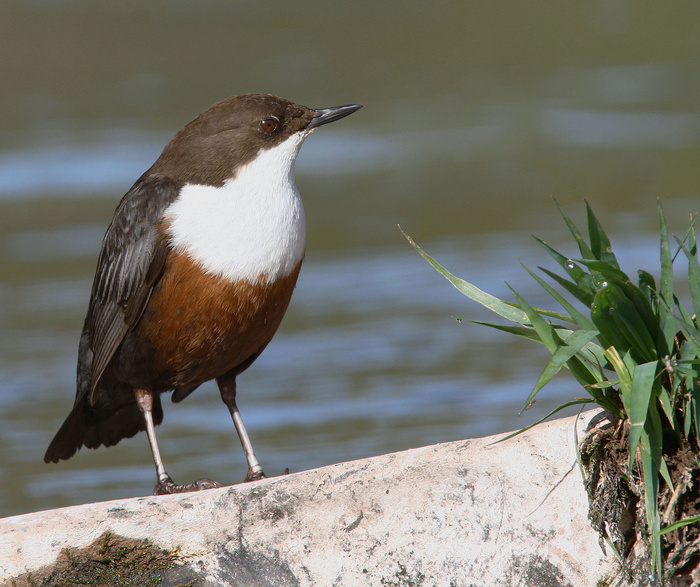
and Grey Wagtails can frequently be encountered. It also cascades over numerous small waterfalls and through deep clear pools where Brown Trout exist in numbers and the enigmatic Lamprey can be found. At certain places and in the right light there are shady areas that are reminiscent of a fairy glen, within which the lucky observer can sometimes see the electric blue flash of a Kingfisher as it darts from overhanging Willows into the river's crystal waters in search of small fish such as Minnow, Gudgeon and the European Bullhead.
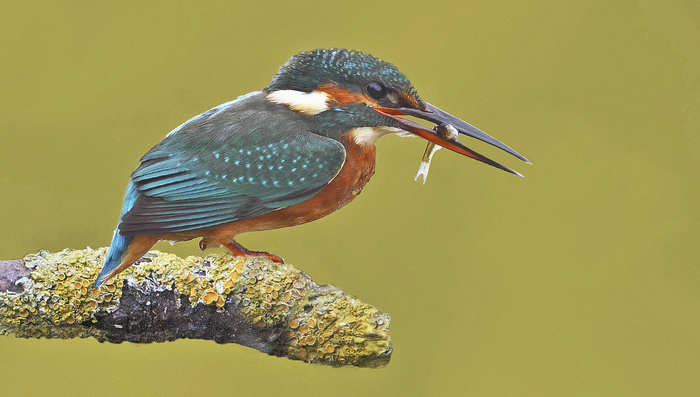
Along its course the Afon Tarell is met by a tributary called Nant Cwm Llwch. This crystal clear mountain stream emerges from the glacial lake Llyn Cwm Llwch situated below Pen y fan, the highest point on the Brecon Beacons and is filtered by black peat before it enters the Afon Tarell.
The Afon Tarell is also designated as a special area of conservation for its three species of Lamprey, Twaite Shad, Atlantic Salmon and Otter.
Please see Landscapes, around the local area.
As it makes its way through this woodland the Afon Tarell bubbles over stretches of rocky, shallow riverbed where Dippers,
and Grey Wagtails can frequently be encountered. It also cascades over numerous small waterfalls and through deep clear pools where Brown Trout exist in numbers and the enigmatic Lamprey can be found. At certain places and in the right light there are shady areas that are reminiscent of a fairy glen, within which the lucky observer can sometimes see the electric blue flash of a Kingfisher as it darts from overhanging Willows into the river's crystal waters in search of small fish such as Minnow, Gudgeon and the European Bullhead.
Along its course the Afon Tarell is met by a tributary called Nant Cwm Llwch. This crystal clear mountain stream emerges from the glacial lake Llyn Cwm Llwch situated below Pen y fan, the highest point on the Brecon Beacons and is filtered by black peat before it enters the Afon Tarell.
The Afon Tarell is also designated as a special area of conservation for its three species of Lamprey, Twaite Shad, Atlantic Salmon and Otter.
Please see Landscapes, around the local area.
Cuckoo Spring 2013
20th June 2013
20th June 2013
The Cuckoo comes in April
He sings his song in May
In the month of June he whistles his tune
And in July he flies away
Not absolutely accurate but a good general assessment of this most charismatic bird.
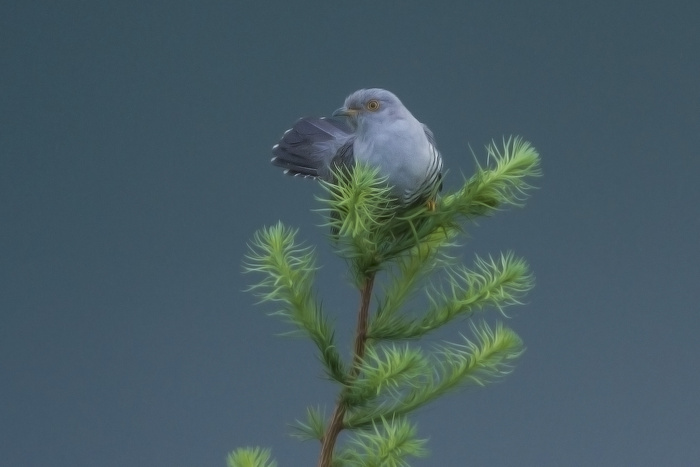
In April some do indeed arrive but mainly down south but in May even here in the Beacons they are in full voice as the males sing for a mate and this goes on throughout June.
Male Cuckoos utter the familiar 'Cuckoo' song but the females only make a soft and beautiful bubbling call as she calls for a mate. They also make a wide variety of noises like rasping, chuckling and snorting sounds as they interact with each other, sounds you wont hear unless you are close to them. However, this female bubbling call usually galvanizes the males into action, they must realize breeding time is short and indeed it is.
The female can be told from the male by a rusty wash around her neck and upper breast, more pronounced on some than others, but if you hear that 'Bubbling' you know it's her.
Once she lays her many eggs in say a number of Meadow Pipit or Reed Warbler nests the job is done and in July they tend to go quiet and are hard to locate. In my experience they are still around until the end of August and even into October on the south coast. Inland, or here for instance they are generally long gone by September and only the juveniles are left to find their own way to Africa.
They really are a smash and grab merchant!
There is a traditional site quite close to me and there Meadow Pipits are the main hosts for their eggs. This spring there have been three Cuckoos there and I have been watching the male closely and I know his favourite perches. I wait until the Meadow Pipits push him off a bush or tree branch and then I wait by one of his 'perches'.
As long as I am quiet, patient and tucked away he will come reasonably close and I can photograph him. I've seen people chasing them around but they are wasting their time, a Cuckoo will make a fool of you every time, they are just too crafty and streetwise to be caught out.
They are a strange looking bird, they can look big and awkward but when they are in flight they look so streamlined, it's quite remarkable. They must be quite dextrous and also lightweight because they land on the flimsiest of branches with ease. They can also appear anything from a dark brown to a leaden grey depending on the light.
I am always sad to see them go but I equally look forward to their return the following spring, long may it continue!
He sings his song in May
In the month of June he whistles his tune
And in July he flies away
Not absolutely accurate but a good general assessment of this most charismatic bird.
In April some do indeed arrive but mainly down south but in May even here in the Beacons they are in full voice as the males sing for a mate and this goes on throughout June.
Male Cuckoos utter the familiar 'Cuckoo' song but the females only make a soft and beautiful bubbling call as she calls for a mate. They also make a wide variety of noises like rasping, chuckling and snorting sounds as they interact with each other, sounds you wont hear unless you are close to them. However, this female bubbling call usually galvanizes the males into action, they must realize breeding time is short and indeed it is.
The female can be told from the male by a rusty wash around her neck and upper breast, more pronounced on some than others, but if you hear that 'Bubbling' you know it's her.
Once she lays her many eggs in say a number of Meadow Pipit or Reed Warbler nests the job is done and in July they tend to go quiet and are hard to locate. In my experience they are still around until the end of August and even into October on the south coast. Inland, or here for instance they are generally long gone by September and only the juveniles are left to find their own way to Africa.
They really are a smash and grab merchant!
There is a traditional site quite close to me and there Meadow Pipits are the main hosts for their eggs. This spring there have been three Cuckoos there and I have been watching the male closely and I know his favourite perches. I wait until the Meadow Pipits push him off a bush or tree branch and then I wait by one of his 'perches'.
As long as I am quiet, patient and tucked away he will come reasonably close and I can photograph him. I've seen people chasing them around but they are wasting their time, a Cuckoo will make a fool of you every time, they are just too crafty and streetwise to be caught out.
They are a strange looking bird, they can look big and awkward but when they are in flight they look so streamlined, it's quite remarkable. They must be quite dextrous and also lightweight because they land on the flimsiest of branches with ease. They can also appear anything from a dark brown to a leaden grey depending on the light.
I am always sad to see them go but I equally look forward to their return the following spring, long may it continue!